Pages

Showing posts with label Pain Management Rights. Show all posts

Thursday, June 9, 2016

End Opioid Prohibition

The media hysterics against opioids, such as The New York Times, ought to be ashamed of themselves!

http://www.theguardian.com/us-news/commentisfree/2016/jun/08/opioid-epidemic-drug-mix-overdose-death

Bob Bee- It's prohibition that serves to ensure opioids are more dangerous than they otherwise would be, due to uncertainty of purity and dosage of unregulated, black market drugs. Thus prohibition makes fatal OD's more likely, not less. Opioids should be legalized, regulated, and taxed like tobacco and alcohol. That way, users would know exactly what they were buying and the dosage. Also, opioid legalization would mean good, old, natural opium would be legally available. Users could opt for opium (active ingredients include morphine & codeine. It can be eaten, smoked, or consumed as a tea) as a safer alternative to ultra-potent pharma-junk powders & pills. Opium's safer as it's less concentrated and is harder to fatally OD on. End the counter-productive, hypocritical, unjust, indefensible war on opioids.


http://freedomofmedicineanddiet.blogspot.com/2016/05/opioid-prescriptions-down-deaths-up-ny.html

Friday, May 27, 2016

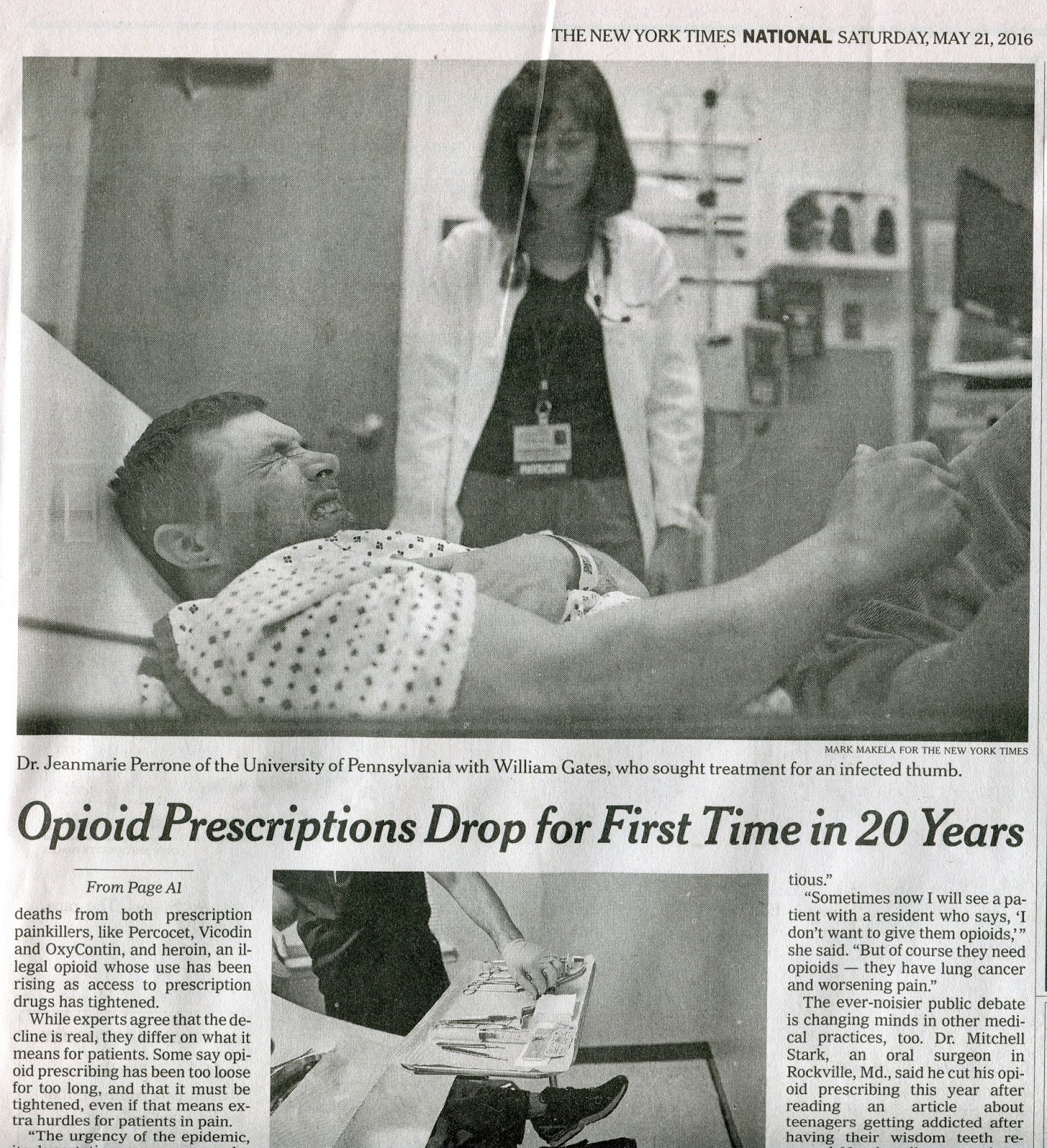
Opioid Prescriptions Down; Deaths Up, NY Times reports


http://www.nytimes.com/2016/05/21/health/opioid-prescriptions-drop-for-first-time-in-two-decades.html?_r=0
(excerpts)
"...for each of the past three years — 2013, 2014 and 2015 — prescriptions have declined, a review of several sources of data shows."

" IMS Health, an information firm whose data on prescribing is used throughout the health care industry, found a 12 percent decline in opioid prescriptions nationally since a peak in 2012. Another data company, Symphony Health Solutions, reported a drop of about 18 percent during those years. Opioid prescriptions have fallen in 49 states since 2013, according to IMS, with some of the sharpest decreases coming in West Virginia, the state considered the center of the opioid epidemic, and in Texas and Oklahoma. (Only South Dakota showed an increase.)" ...
... One important development that may have helped propel the decline came in 2014, when the federal government tightened prescribing rules for one of the most common painkillers: hydrocodone combined with a second analgesic, like acetaminophen. In the first year after the measure took effect, dispensed prescriptions declined by 22 percent, and pills by 16 percent, according to an analysis in JAMA Internal Medicine. Refills — which the change made much more difficult — accounted for 73 percent of the decline.

Yet:
" So far, fewer prescriptions have not led to fewer deaths: fatal overdoses from opioids have continued to rise, taking more than 28,000 lives in 2014, according to the most recent federal health data. That number includes deaths from both prescription painkillers, like Percocet, Vicodin and OxyContin, and heroin, an illegal opioid whose use has been rising as access to prescription drugs has tightened."

The NY Times article reports this has led to a controversy. 
While experts agree that the decline is real, they differ on what it means for patients. Some say opioid prescribing has been too loose for too long, and that it must be tightened, even if that means extra hurdles for patients in pain.

“The urgency of the epidemic, its devastating consequences, demands interventions that in some instances may make it harder for some patients to get their medication,” said Dr. Nora Volkow, the director of the National Institute on Drug Abuse. “We need to set up a system to make sure they are covered. But we cannot continue the prescription practice of opioids the way we have been. We just can’t.”

Others argue that efforts to rein in prescribing have gone too far and are penalizing patients who take the medicines responsibly and need them for relief.
Indeed, such efforts have led to a growing fear among doctors to prescribe opioids in general.
“The climate has definitely shifted,” said Dr. Daniel B. Carr, the director of Tufts Medical School’s program on pain research education and policy. “It is now one of reluctance, fear of consequences and encumbrance with administrative hurdles. A lot of patients who are appropriate candidates for opioids have been caught up in that response.”...
... Dr. Mitchell Stark, an oral surgeon in Rockville, Md., said he cut his opioid prescribing this year after reading an article about teenagers getting addicted after having their wisdom teeth removed. Now he tells even patients recovering from multiple extractions to try prescription-strength ibuprofen first.
“I don’t want to be the person who gets a call from someone saying, ‘My kid had an overdose with the Vicodin he had left from getting his wisdom teeth out,’” Dr. Stark said.
Yet further restricting prescriptions for opioids has led to other worsening problems.
Many experts say that the drop in prescribing is at best a half victory, in light of the rise of deaths from heroin and illicit fentanyl, a powerful synthetic painkiller. Some addicts who started with prescription painkillers are merely turning to such street drugs or getting their hands on prescription drugs by other means.

“We are seeing, in our area, many more pharmacies being robbed,” said Dr. Richard Vaglienti, the director of outpatient pain services at WVU Medicine, a health system in West Virginia.

Interestingly, these policies relay heavily upon lumping different matters together.

Different types of users.

And especially, different types of opioids in general, particularly the lumping together of pills which are of known predictable potency, with black market 'heroin' of vastly variable potency, and even adulterated with far far stronger opioids as fentanyl.

It is as if they view predictability of potency almost irrelevant.

Let alone  the type of user.  Such as those who take relatively modest doses, versus those that massively escalate their doses, especially those who instead take them not orally by mouth as intended, but those who grind them up to sniff them or to dissolve in a solution to be injected.

The May 21, 2016 NY Times article does not delve into any of this, including neglecting to mention that escalation to serious physical addiction via overuse-abuse is confined to a small minority of prescription receivers.  In other words, punish most consumers for the actions of a small minority, never-mind that such would be seen as insane if for instance applied to consumers of alcoholic beverages (despite alcohol actually being far more potentially toxic than opioids!!!).

Nor does it delve into the matter qualitatively, by choosing to focus simply quantitatively upon the number of prescriptions and pills for such issued.  Though it quotes NIDA's Nora Volkow as saying that "... we cannot continue the prescription practice of opioids the way we have been. We just can’t...", the article simply fails at any analysis that is qualitative rather than quantitative.  For instance, failing to ask such questions as:


- why prescribing doctors insist that opioids be taken regularly rather than more infrequently.

- why they must only be made available in far more easily abuse-able concentrated forms.


Educating people on how to use and how not to uses opioids would reduce problems as overdoses.  Such as do not take too frequently, nor escalate the dosage to compensate for tolerance, nor mix with certain other drugs, as many fatal overdoses involve such, rather than an opioid alone.

Making opioids available in safer forms, such as those more dilute and perhaps not very tasty would likewise discourage overuse.

Likewise, the availability of products to occasionally 're-set' one's level of tolerance, such as with Iboga-Ibogaine, as an alternative to more synthetic forms of opioids as methadone and buprenorphine that require regular use and may be more physically addictive than the opioid they are used to replace.

Education, combined with safer forms would serve to counterbalance making opioids more available, while undercutting the black market.

Current policies to not educate people, to increase doses, to provide only in abuse-able concentrated forms, and to encourage continued use via such highly questionable more recent practices as drug testing patients to ensure they are taking their opioids frequently, and cutting off such prescriptions, all serve to steer people towards black market heroin.

Even reforming the prescription system to allow metered, rationed refills over longer periods of time, based upon a patient's needs -- aka injuries -- would be a step in the right direction.   Since many people have suffered like injuries, why has not the medical profession developed a guide for such a rationing, at least for lower doses?  Indeed, why has the medical profession so tolerated a government meddling in medical prescribing since 1915, so lacking in any concrete definitions of "professional [medical] practice", since the initial 1914 U.S. Harrison Act's delegation of regulatory authority to the U.S. Department of Treasury?!

If the State of Montana's "reasonable and prudent" speed limit could be struck down as unconstitutionally vague, how about the entire regulatory meddling in opioid availability?

Why is the medical profession generally so complacent?

Why do they not challenge such policies?

Because current policies are designed primarily to increase costs and thus profits.

Reforming opioid availability would reduce the need for separate visits to a doctor for each refill.

More dilute forms of opioids to displace pills would mean less profit per shelf space.

More alternatives, particularly those for reversing tolerance, would undercut the "treatment" industry empire, including that of methadone, buprenorphin, all requiring separate visits to doctors, let alone the cultivated guilt placed upon addicts to opioids dissimilar to those of say nicotine.

Thus they choose to blur together different types of users, along with different general types of opioids- aka measured dosage pills with variable strength 'heroin, to actually undermine health, including by undermining efforts to provide safer legal forms of opioids to consumers- never-mind that opioids are arguably far far less toxic than the abuse of alcohol let alone the regular use of mass marketed Tobacco.

For what they are doing is part of a political agenda, to maintain a set of policies set in place during the early 1900s- which includes the "great" drug war, as part of a broader agenda of centralized control over the fields of medicine and diet.

One that was sold to the public as a means of serving their health, but in fact subvert such by interfering with markets to reduce choice for the benefit of those interests that saw and used such means to protect and advance their own markets via criminalizing their competitors.

From the numbers of medical schools and health care providers- aka the American Medical Association/Flexner Report.

To the types of drugs in use, via a process of elimination favoring not what was necessarily safer, or more effective, but rather what was more potentially profitable if not better established.

As with any propaganda campaign designed to deceive, that which brought this agenda about had its share of terms used to confuse the general public.  "Patent Medicines" in fact would be those that would be patented as they were man-made rather than natural creations- aka pharmaceuticals rather than herbs, plants found in nature.  Yet that term would be flung at what were actually "proprietary" medicines -- trademarked names upon man-made mixtures of natural substances as extracts of herbs, which could not themselves be patented and thus could not be monopolized, and which were generally preparations- products that were dilute liquids intended to be drank, and hence far bulkier than highly concentrated powders and pills.  Hence, scaring people away from un-patentable herbs and bulky liquid medicinal products meant using such prerogatives as "nostrums" and 'quackery".  And such a disfo campaign, as that promoted in the ironically named "The Great American Fraud" article series in Colliers Magazine authored by the 'muckracker' Samuel Adams Hopkins in collaboration with U.S.D.A Bureau of Chemistry Chief Harvey Washington Wiley (who also served with the American Medical Association-American Pharmaceutical Association), would rely heavily upon confusing the potential dangers of highly concentrated derivatives as morphine and cocaine in powder forms with the parent substances of Opium and Coca, with an utter disregard of dosage matters of potency and route of administration.

As could be expected with such a deceptive campaign, it was used to achieve passage of the U.S. Foods and Drugs Act of 1906, that, though not outright prohibiting any substance, would be the steeping stone to prohibition.  Ostensibly, it mainly required the labeling of the amount of certain substances in food and drug products; yet, the 1906 Act would grant dictatorial power to Wiley's U.S.D.A. Chemistry Bureau to prohibit from interstate commerce any product containing a substance which he/it deemed 'dangerous' or 'deleterious to human health' - without any required scientific backing!   Though the Act would for instance include cocaine as a substance required to be labeled, Wiley's Bureau wasted little time in prosecuting beverage manufacturers for "adulteration" for containing a supposedly dangerous and deleterious ingredient, with absolutely no showing of any actual harms to health for the relatively low concentrations of cocaine present, generally 1/2 to 3 milligrams per fluid ounce, and never-mind the implied legality via cocaine's inclusion within the labeling requirement list not only for products sold as medicines but as well as those sold as foods (aka more frequent use).  The subsequent push to eliminate cocaine, irregardless of how dilute and harmless the amount, from commercial products, including those sold as medicines, came with the legislative campaign to limit such products to prescription use only, and make such prescriptions non-refillable.  Such was what brought about the U.S. Harrison 'Narcotics' Act of 1914.  Though that Act would still allow over the counter sales of lower potency opiate preparations containing under  "two grains of opium, or more than one-fourth of a grain of morphine, or more than one-eighth of a grain of heroin . in one avoirdupois ounce", it made no such allowances for cocaine, regardless of how low the amount.

As should be expected from such a deception, this campaign was not about reducing addiction nor serving the public health.

It grossly confused Opium and Coca with highly concentrated forms of opiates and cocaine, thus rendering any such remaining popular use of such substances in their most dangerous forms, owing to the dynamics of prohibition 's iron law of shifting availability to ultra concentrated forms.

Though it arguably reduced the total size of the drug using population of opiates and cocaine, it hardly reduced the overall size of the population of people who used drugs as it served to protect and promote other competing drugs- particularly mass marketed Tobacco.

Such were more physically addictive than even heroin, and far deadlier from chronic use.

That latter fact can be true regarding non opioid pain killers, as Tylenol with their ill effects upon the liver.

Yet one would not likily realize this from the relative official attitudes towards these different classes of substances.

See also:


http://freedomofmedicineanddiet.blogspot.com/2016/03/more-reporting-should-be-done-on-lives.html

http://freedomofmedicineanddiet.blogspot.com/2016/02/how-about-methadone-model-for-nicotine.html


Monday, March 28, 2016

More reporting should be done on the lives saved and enhanced by opioids, addressing chronic pain, sleep disorders and associated depression.


http://www.nytimes.com/2016/03/27/opinion/sunday/opioid-use-and-abuse.html?_r=0

To the Editor: Re “A Strong Response to the Opioid Scourge” (editorial, March 17):

There are longtime users of low-dose opioids, like me, who never require an increase in dose and who find that this medication provides quality of life. How? By addressing chronic pain, sleep disorders and associated depression.

The alternatives proposed by the Centers for Disease Control and Prevention, like aspirin and ibuprofen, can cause long-term damage to body organs and short-term stomach pain. For many of us, spare use of a low-dose opioid is the very best alternative.

Unfortunately, voices like mine are not heard often. Why? Because the media climate right now is so fiercely anti-opioid that those who rely on this drug can feel hesitant to speak out. More reporting should be done on the lives saved and enhanced by opioids, in addition to the terrible consequences of addiction. Policy should reflect a more complete picture of this important medication.

KATHERINE CAMERON
Alameda, Calif.
The writer is a social worker.


To the Editor: The proper treatment of pain disorders by physicians should not be directed by the fear of lawsuits or pressure by insurance payers but rather by sound guidelines developed by organizations like the American Academy of Pain Medicine.

The news media has readily noted a “prescription drug epidemic,” but overdoses mainly result from drug diversion and misuse rather than from taking an opioid as prescribed. Epidemiological data has reported up to 16,500 deaths a year from the aspirin-ibuprofen family of medicines, which can cause ulcers, kidney failure and liver inflammation, none of which occur with opioids.

The major health issue for an opioid is addiction, which rarely occurs in a properly selected and treated patient. One must understand the difference between dependency and addiction.

Chronic, nonmalignant pain conditions are difficult to treat. Physician judgment is crucial and should not be inhibited by arbitrary limits that are not supported by the data.

LESLIE SCHOFFERMAN
San Francisco
The writer is a pain doctor.


To the Editor: For many people with chronic pain, opioid painkillers are a lifeline. The new guidelines from the Centers for Disease Control and Prevention, while perhaps reasonable as a first approach, are unrealistic for patients who have done well (sometimes for years) on carefully monitored opioid doses under continuing medical care. As The Times has reported, these longtime patients must now be subjected to humiliating “pain contracts” and random drug tests.

Acetaminophen and ibuprofen are just short of laughable: If they worked for severe pain, no legitimate patient would be taking opioids. Nonpharmacological solutions like physical therapy and acupuncture may be effective for those who can afford them but are subject to strict, onerous insurance limitations or not covered at all.

It’s hard not to conclude that the politics of the very real and tragic opioid addiction crisis are drowning out the cries of people in pain. The medical profession only recently began to give serious attention to complaints of chronic pain, which not incidentally affects many more women than men.

Sadly, it looks as if a return to the bad old days will be upon us very soon.

LOIS AMBASH
Needham, Mass.

Friday, February 26, 2016

Trump To Increase Opiate Deaths By Further Popularizing DOMESTIC Fentanyl

by building a wall with the said goal to stop contraband drugs as his response to heroin


The "success" of this sort of policy would be to favor domestically produced bathtub "heroin" that would be likely spiked with the far more potent synthetic opiate fentanyl, in of course vastly varying potencies, unregulated thus promoting even more fatal ODs.

By banning Opium and its derivatives, the market availability was shifted to the more concentrated forms of opiates as Heroin HCI, and with the price likewise artificially increased to be pricier per weight than gold, encouraged its use in the way with the greatest 'bang for the buck" of injection- also the most addictive and potentially dangerous- further exacerbated by the variable potency of such a substance in an unregulated black market of uncertain purity and adulteration perhaps with something even stronger such as fentanyl.

By failing to address any of this Trump shows that he fails to understand basic economics, that he would rather pander to stupidity by supporting the very polices making the problem far far worse, that he would fail to even attempt to explain that, and that he is a shill for the powers that be that gave us this mess over a century ago.

Monday, February 22, 2016

How About A Methadone Model For Nicotine?!

if the polices towards opiates are really so valid, why not then apply them to other drugs, such as nicotine?


Virtually anything and everything written about the various "epidemics" of heroin and opiates or opioids treats the policy as if it were written in stone by God.

Regular use of such can not be tolerated.

People must be gotten off opiates, or rather off of their regular opiates and onto something longer lasting and stronger and more physically addictive.

From what one would gather, this is because the regular use of their regular opiates must be associated with various sorts of diseases and/or ill effects upon health.  That staying on say pain pills or heroin is intolerable because such invariably harms health.  Perhaps as that with the excessive use of alcohol causing cirrhosis of the liver.  Or that of the regular use of Tobacco, particularly the type bred for cigarettes and especially so when so adulterated for such, causing lung cancer and other diseases.

Given the degree on non questioning to that line of thought and policy, one must assume that the more potent opiate substitutes were somehow less harmful.  All of this never-mind the relative safety of pharmaceutically produced consistent measured dose pain pills with buffers to facilitate and regulate the absorption taken orally, versus that of contraband 'heroin' of vastly inconsistent varying potency from the degree that it is cut with adulterants that are inert, as well as those that are not as the far more potent synthetic opiate fentanyl.

Policy is so fixated upon "getting people off of their regular opiates" that it dictates physicians to discontinue patient's prescriptions to the relatively safe measured dose pills meant for oral use, thus driving some to the far more dangerous unregulated "heroin".   Indeed, this policy is so fixated that it lumps together the over-does fatalities of the regulated pills and the unregulated heroin- all in an appeal to emotion designed to protect and strengthen the markets in the latter.

Even factors about the policy of prescribing pain pills appears to be designed to make this worse, by denying such to patients with an occasional need for such, by limiting them to those for chronic -- all the time -- use.  As after all, patients can avoid physical dependence by not using them too frequently, say daily for more than 3 weeks, or only when needed, skipping days of little or no pain, and not escalating the dose, or if so, only moderately.   More recent prescription policies to ensure regular use, complete with drug testing requiring a dirty result for a refill, along with admonishments to not skip days, all serve to increase the likelihood of physical dependency- never-mind the lip service given to combating such.  hence, a great many people are unjustly denied needed pain medications, while others are shoehorned into patterns of use designed to foster addiction.  Ah, a medical profession that does not look out for patients, except for the sake of creating new ones for overly priced drug addiction treatment that would not even be needed if people could simply chose to maintain their dependencies, step away via stepping down their consumption, all with predictable, inexpensive pharmaceuticals, or better yet, preparations based more upon natural Opium, or break their dependencies with legal Ibogaine.

Though policy can't allow people their safe regulated supplies of Opium, hydrocodone, or even heroin, as it will not tolerate physical addiction, it must insist upon making such a situation arguably worse via its reliance upon programs of  maintenance based upon versions of opiates that are even more physically addictive, as methadone and more recently Buprenorphine.

Of course the idea is for people to be on something that is longer lasting for the sake of being something with a stable effect so they can lead more or less normal lives, rather than say the peaks and valleys of say injecting heroin.

Never-mind, that at least with the pills, people are capable of that, and with such they could take smaller doses to advert withdrawal while not getting super-high.

Indeed, when opiates were legal, many people lived more or less normal lives even as physical addicts to opiates, and especially so when their use of such was by some oral preparation, or perhaps even the smoking of whole Opium, rather than something hardcore as heroin by injection.   Small amounts of say an oral preparation would avoid withdrawal while not providing such a strong effect as to incapacitate, and the stuff was inexpensive, thus avoiding the situation under prohibition of the price being so horribly inflated to compel people to rob or burglarize to fund their consumption.

Prohibition of opiates, indeed of "Opium, Coca leaves and their derivatives" seriously affects drug use.  It eliminates the dilute more natural forms and preparations of such substances, shifting their market availability to ultra refined concentrates, which are infinitely more potentially problematic.  It removes any regulation of consistency of potency.  It tremendously drives up the prices, so what would otherwise be pennies is now pricier per weight than gold.  And it promotes more intensified modes of dosing for the greater bang for the buck as that of injection- all things that conspire together to create greater addictiveness and likelihood of a lethal overdose.

Nonetheless, this is a policy supported on both sides of the political spectrum, for the supposed sake of fighting drug abuse, even sadly enough by Bernie Saunders.  And thus is a policy supported even by a great many people who otherwise do see through the fraud of the prohibition of Cannabis, who correctly note that Cannabis is neither physically addictive nor toxic, yet who fail to grasp to the degree that prohibition actively makes matters far far worse for other such substances as opiates- or Coca/cocaine- itself a stimulant that is non physically addictive, but in concentrated form can invite overuse with toxic-mania.   Though cocaine is in fact only problematic in ultra concentrated forms, regarding actual matters of drug abuse, it was banned in all forms, in the U.S. via a political campaign at the national level coordinated through the USDA and the AMA-APhA starting cir 1904-1905 that primarily targeted its availability in the relatively safe dilute forms as soft drinks similar to the original Coca-Cola (1-3 mg cocaine per fluid ounce) and Vin Mariani (6 mg cocaine per fluid ounce), never-mind the real problems of abuse with the cocaine containing sniffing powders sold as catarrh cures, and the horrors of cocaine injections in anesthesiology.

The savage early 20th century demonification of both Opium and Coca without regard to matter of potency, healthiness, toxicity nor abuse potential, worked hand in glove with the simultaneous demonification of the idea of dilute medicinal preparations based upon herbs (via the muckraker slur term "nostrums" through the infamous Colliers Magazine "The Great American Fraud" disfo campaign), along with the simultaneous free pass given to Virginia Bright Leaf Tobacco cigarettes.

Ridding pharmacies and supermarkets of dilute Opium and Coca leaf retail products would not only reduce the amount of such drug consumers, while shifting the reduced consuming population towards the infinitely more problematic concentrated 'hard' forms of these drugs, but it would shift people in general away from dilute preparations based on herbs in general and towards the now freed from the competition product of the Virginia Bright Leaf Tobacco cigarettes- "Virginia Bright Leaf" being a variety initially bred a few decades earlier as a reduced nicotine variety designed to be smoother smoke for deeper inhalation, with the introduction of mass machine produced cigarettes cir 1884 enjoying relatively modest sales growth for more than two decades, until their initial two major spurts in sales respectively in 1907 and 1915- notably the years immediately following the U.S. 1906 Food and Drugs Act and the 1914 Harrison 'Narcotics' Act.

The 1906 Act would empower the USDA to ban from interstate commerce as "adulterated" food products containing ingredients that it decreed as deleterious to human health.  Never-mind that the Act included cocaine and opiates as ingredients that had to be labeled and thus were presumably legal; the labeling requirement was questionable and could serve as a suicide list insofar that it would be presented as limited to things 'bad" enough to be required to be labeled, whereas for instance caffeine and nicotine where not included; and the USDA powder to declare a substance "deleterious" required no scientific showing.  Notably, the USDA-AMA was especially concerned about the use of dilute cocaine; first by going after soft-drink manufacturers, whether those cowed into "mis-branding" for failing to label the cocaine content, even if labeled as Coca, or for so-called "adulteration"; subsequently with campaigning to amend the 1906 Act with federal bans upon such products even sold as medicines outside of a non-refillable prescription; and by 1910 with a blatant admission within an infamous USDA Farmer's Bulletin article "Habit Forming Agents- Their Sale and Use a Menace to the Public Welfare" of their particular "concern"- Coca being sold and used as a "Tobacco Habit Cure"!  But of course as Coca and Tobacco are both stimulants with overlapping uses, with Coca a foreign tropical plant that the USDA would confirm in 1904 required hothouses to be grown in the USA, while Tobacco was long established, especially throughout the southeast where there was all of this newspaper reported concern over Blacks on cocaine.

The 1914 Harrison Act would go further by denying the over the counter sale of any product containing any amount of cocaine alkaloid without a physician's prescription that was non-refillable, and likewise for those containing anything more than a small amount of opiates, with the sneaky inclusion of a requirement that such prescriptions be within the course of professional medical practice only, with the authority to define such given to the U.S. Department of Treasury- again without any requirement of any scientific basis.  Subsequently, the U.S Department of Treasury would issue regulations prohibiting maintenance doses for opiates, which would be upheld in the courts, both the D.C. Superior Court and the U.S. Supreme Court.  Likewise, subsequent policies would eliminate the availability of OTC preparations that contained small amounts of opiates initially allowed under the 1914 Harrison Act, thus eliminating the options of people maintaining or stepping down their opiate doses inexpensively and relatively safely.  But of course, as the whole market in medicines was being shifted generally away from herbs and dilute medicinal preparations and towards synthetics and concentrated preparations as pills, given that herbs could not be patented, whereas synthetics could, while concentrated preparations meant greater  monetary value per shelf space, with required physician visits all conspiring to vastly drive up costs and profits.

Such a pharmaceutical-Tobacco political alliance, further evidenced by the multitude of 20th century medical journal cigarette advertisements with the medical profession's virtual endorsement of such, as those facilitated by AMA President and self-proclaimed 'quack-buster' Morris Fishbein, had nothing to do with actually serving matters of the public's health, and everything with controlling markets in violation of basic human rights for the sake of maximizing profits, with negative ramifications extending throughout the field of health care through the popularization of more profitably and toxic synthetic pharmaceuticals.

Thus, with so many people failing to question our drug polices beyond the general issue of recreational and medicinal Cannabis (Marijuana), virtually everything being echoed in the mass media since about the other substances targeted by the continuing Inquisition of the drug war, is the same old, same old- to wit, that which is now being parroted about "Opioids" - the new name for Opiates.

- We have a new epidemic of heroin
- It is to be blamed upon the availability of newer opiate pain pills placed on the market during the 1990s.

Components of this are:

- blurring together OD deaths from the pills and the contraband "heroin"
- the assumption that the increase in heroin use is from people who started on pain pills
- sloganeering claims that pain pills are being prescribed- handed out "like candies" when in fact many doctors are afraid of prescribing them owing to intimidation by the government in place since 1915 with the abusive practices started via the U.S. Department of Treasury.
- a disregard that most people on pain pills don't go on to intensified abuse- as if we must make vodka prescription only because of its abuse by a subset of alcohol consumers.

Never-mind that ODs are generally from users not knowing the actual potency, and from not being educated about how tolerances to opiates go down during times of abstinence.  As pain pills represent predictable fixed doses, it is strange that suicides are generally not mentioned as the motive in at least some fatal ODs via the pills.

Never-mind that the oral use of pain pills and the popular use of heroin by injection are two radically different things.

Never-mind that only a small percentage of persons prescribed pain pills go on to heroin, by sniffing let along by injection.

Never-mind that it would be helpful to provide a breakdown among those that do, of what doses they were prescribed, and if they had a pre-history of excessive pain pill use or heroin use.

So if so many are to accept the drug war approach to opiates, then how how doing so with, say nicotine?

Nicotine addiction, it could be said, leads to about 500,000 premature deaths annually within the U.S., and over 6 million annually worldwide, through the mass consumption of cigarettes.

Now it can also be said that nicotine addiction can be separated from that of Tobacco, particularly cigarettes.

That we can maintain people on nicotine without conventional cigarettes.  E cigarettes can deliver nicotine via a relatively non toxic vapor- asides from the issue of whatever is contained in the flavoring.

Nicotine can be delivered alternatively by patch.

And by chewing gum.

And even by beverage.

All of these are currently OTC, except for the form of the beverage which the U.S. FDA moved to stop about 10 years ago regarding a product "Nica-Water" which contained 2 mg for a 12 ounce serving.

These all use the nicotine alkaloid which occurs naturally in Tobacco, presenting it in an appropriately dilute form, and do not present toxicity when used as directed.

Of course they can be toxic if abused, say with the simultaneous application of multiple patches and/or sticks of gum.  But so can caffeine pills, also OTC.  Let alone alcoholic beverages, particularly and especially distilled spirits, also all OTC.  We hear little about such abuses of nicotine and caffeine- instances of fatal ODs on say caffeine powder are sufficiently newsworthy to be occasionally reported, whereas those with alcohol are sufficiently common to go unreported.

Now it is said that we tried alcohol prohibition and that it was a failure for making things worse.

But almost no one it seems, says that about the policies of the drug war for say opiates, while of course we never tried such a policy nationally for Tobacco/nicotine.

So, if we are to have such policies towards opioids, then how about for Tobacco/nicotine?

Ban cigarettes.  Not simply the production, promotion, advertising, manufacturer and sale, but also the private possession, even on private property.

Ban Tobacco seeds and plants.  Ban private cultivation.

Also ban all nicotine containing products.  No more e cigarette liquids that contain nicotine.  No more nicotine patches.  Or chewing gums.  At the very least enact all of these bans outside of the confines of a non refillable prescription.   But better yet go further, as there may be hidden dangers in the continual availability of such products, whether perhaps the additives within the e cig liquid flavoring agents, or perhaps the food dyes in the gums, or something perhaps with the long term use of patches upon the skin.  Don't bother allowing such products without flavorings or dyes, as what follows is our true goal. 

Establish a vast new empire of nicotine addiction treatment facilities!

Refer all nicotine addicts to a "methadone" model clinic system.  Create vast new amounts of openings in employment in the drug treatment industry and bill the general public through tax and or insurance premium increases.

Develop longer lasting analogs of nicotine to satisfy the withdrawal/cravings, never-mind that such substances may be more physically addictive than nicotine itself.

If people are to continually believe that this is such a great policy towards opiates, than why then not apply it to nicotine?

Or better yet, have them see that such suggestions for nicotine would be about as insane as our prohibitionist-medicalized policies towards opiates, including that even of using pills rather than even safer more dilute versions of natural opium. 

But that would draw too much attention upon the larger picture of the medical establishment's political rejection of herbs in favor of more expensive and potentially dangerous pharmaceuticals.
http://freedomofmedicineanddiet.blogspot.com/2013/01/stop-overlooking-opium.html
http://freedomofmedicineanddiet.blogspot.com/2016/02/points-about-progressive-era-war-of.html
http://freedomofmedicineanddiet.blogspot.com/2012/07/legalize-coca-opium-not-just-marijuana.html

Monday, December 26, 2011

Siobhon Reynolds RIP

Killed in plane crash


excerpt-

She was tireless. I often thought she was a bit too idealistic, or at least that she set her goals to high. She told me once that she wouldn’t consider her work done until the Supreme Court declared the Controlled Substances Act unconstitutional. She often frustrated efforts to build a coalition on the issue because she’d grown weary of medical organizations and academics who, while concerned about the issue, she thought were too cowardly to take a more aggressive stand.

http://www.theagitator.com/2011/12/26/siobhan-reynolds-rip/

Founded the Pain Relief Network.

By spotlighting the criminal prosecution of pain management physicians, she incurred the wrath of a criminal government.

http://www.slate.com/articles/news_and_politics/jurisprudence/2010/12/the_worst_kind_of_ham_sandwich.single.html