From my unpublished manuscript
"Coca- Forgotten Medicine"
"... We have received valuable advice from Marialuisa Gallozzi, the Covington and Burling associate assigned to take primary responsibility for advising the Foundation. Having Covington and Burling in our corner is a source of great comfort.”
Arnold Trebach and Kevin Zeese, letter dated March 1990
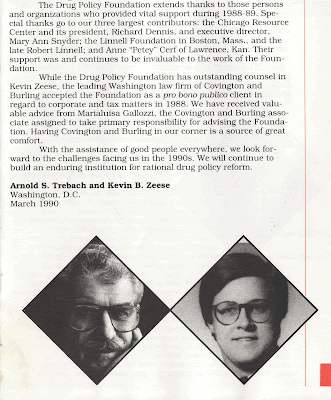

Marialuisa S. Gallozzi (“M.L.”) -- born December 22, 1961[1] – “the Covington and Burling associate assigned to take primary responsibility for advising the [Drug Policy] Foundation” is a partner in the insurance and food and drug practices, admitted to the bar in the New York,1987, and the District of Columbia, 1988 (graduated Harvard University, A.B. cum laude, National Merit Scholar, 1982, and N.Y.U. Law School, J.D. 1986; clerked for Judge Robert G. Doumar E.D. Virginia; subsequently hired at Covington and Burling), according to Covington & Burling’s web site in 2005.
In the insurance area, Marialuisa assists policyholders in settling and mediating coverage disputes and designing insurance portfolios. She works with Bermuda, London Market, U.S. and captive insurers and with a range of traditional and new insurance products. She has extensive experience in asbestos, silica, pharmaceutical and medical device and other coverage claims as well as in insurer insolvencies. Her recent presentations include
"Settlement Credits and Excess Insurers" (
Mealey's Allocation and Settlement Credits Conference, Nov. 2005) and
"Solvent Schemes: Running Off or Running Out?" (
Mealey's Advanced Insurance Coverage Conference, Jan. 2006).
Marialuisa is listed in the Guide to the World's Leading Insurance and Reinsurance Lawyers (Euromoney 2004) and
The International Who's Who of Insurance & Reinsurance Lawyers. She has co-chaired several
Mealey's insurance conferences. In the food and drug area, Marialuisa advises corporations and trade associations on FDA regulation of products including OTC drugs, food, dietary supplements, and medical devices. Her work has involved federal regulation of agricultural biotechnology and plant-based pharmaceuticals.
Her article,
"Inactive Ingredients in Over-The-Counter Drug Products", appeared in Regulatory Affairs FOCUS in August 2002. Marialuisa serves as a civil case and child protection mediator in the Superior Court of the District of Columbia. The National Head Start Association named her a 25th Anniversary Star Honoree for her long service to that organization.
The 2004 version, ended with the following line that would be dropped from later versions: “She likes travel, bicycling, photography and cooking”.
Lexis-Nexis lists her practices in these areas of law: Food and Drug Law; Insurance Coverage; Mediation, though without indicating when she entered each.
 This 2005 Covington & Burling Marialuisa Gallozzi biography fails to mention her recent paper with regards to agricultural biotechnology and plant-based pharmaceuticals regulation about GMO plants for growing patentable drugs that she is listed as presenting at the U.S.D.A. February 2004 Annual Conference “Ensuring a Healthy Food Supply". She was listed as one of three presenters in a panel “Promise and Pitfalls of Plant-Made Pharmaceuticals And Industrial Compounds,” moderated by Neil E. Hoffman, Director, Regulatory Programs, Biotechnology Regulatory Services, Animal and Plant Health Inspection Service, USDA. Her paper was titled “The (U.S.) Food Industry’s View About the Development of Plant-made Pharmaceuticals and Industrials.” [2] It was only available on the internet briefly in 2004, and of the more then 75 speaker presentations at that 2004 USDA conference, is the only one where both paper and its author are deleted from the later html version of the conference schedule, without replacements.
The firm’s website makes no mention if she has worked in drug policy reform issues, nor the pro bono publico client relationship with the Drug Policy Foundation. The various reports by the Drug Policy Foundation subsequent to 1988-89 report’s March 1990 letter omit any mention of this pro bono publico Covington & Burling/Marialuisa Gallozzi/Drug Policy Foundation connection, nor any other such relationship with any other attorneys or law firms. The description that she was “…assigned to take primary responsibility for advising the [Drug Policy] Foundation” would suggest that any such advice from Covington & Burling to the Drug Policy Foundation, regardless of the physical parties, would be filtered and conceivably decided by her.
The Covington and Burling website (Health page, early 2005) acknowledged that the law firm has worked closely with the Drug Policy Foundation and other organizations involved with drug policy reform:
Commonwealth v. Hutchins. We represent Mr. Hutchins and the interests of similarly situated patients for whom the medical use of marijuana is necessary, in a variety of state and national initiatives aimed at decriminalizing such use. We work closely with the Drug Policy Foundation, the Marijuana Policy Project and sympathetic members of Congress and selected state legislatures. American Civil Liberties Union - Drug Policy Litigation Project. We were asked to assist the ACLU in preparing a letter to the Drug Enforcement Agency in support of an application by a professor at the University of Massachusetts for registration to manufacture or distribute controlled substances for the purposes of a scientific study on medical marijuana. Specifically, they requested that we opine on the consistency of the application with the United States' treaty requirements pursuant to the 1961 Single Convention on Narcotic Drugs. We have continued to provide advice on related aspects of this matter.
[1] Lexis-Nexis search: http://www.lawyers.com/find_a_lawyer/search/atty_profile.php?attyindex=0&firmlid=355425&attylid=355474&attylids=355474&lids=&country=&firmname=&firstname=Marialuisa&lastname=Gallozzi&searchtype=N&termtype=2&personalaop=&personalterm=&businessaop=&businessterm=&language=&pagenum=1&city=&county=&state=&country=&resultcount=&displaycount=&sorttype=&sed=&ts=0 [2]“U.S. Food Industry’s View on the Development of plant-made Pharmaceuticals and Industrials” by Marialuisa Gallozzi is listed in PDF http://www.usda.gov/oce/forum/Archives/2004/Program/2-10final.pdf and other fixed format versions of that conference’s published schedule, with its author’s name appearing with two other panelists, Barry Holtz, CEO, Inflexion Therapeutics, who gave a presentation “Moving Products into the Clinic: The Next Stage of Development for the Plant-made Pharmaceuticals Sector” and Rachel G. Lattimore, Attorney, Arent Fox Kintner Plotkin & Kahn, PLLC, who gave the presentation “Plant-Made Pharmaceuticals Confinement Systems”.
However, later html achieves
http://www.usda.gov/oce/forum/Archives/2004/speeches/speeches.htm#promisepitfall
delete both this paper regarding the topic GMO plants for growing patentable drugs, otherwise known as "Plant Based Pharmaceuticals" or "Plant Made Pharmaceuticals"and its author’s name on the list of panelists- apparently purged, according to a USDA research librarian who could find no way to access this paper. (Other such papers that are not available are nonetheless otherwise still listed along with their authors’ appearance upon their respective panels).

From
“The (U.S.) Food Industry’s View About the Development of Plant-made Pharmaceuticals and Industrials” by Marialuisa Gallozzi, viewable
here
Mention of this paper was subsequently added in her Covington & Burling biography which appears in the following 2008 version:
Marialuisa ("ML") Gallozzi is a partner in the insurance coverage and food and drug practices.
Her insurance advisory practice focuses on: negotiating settlements of insurance coverage disputes; advising policyholders on the insurance aspects of transactions; negotiating and analyzing terms of policies, including clinical trials, patent and other specialty coverages; and representing policyholders in claims against insolvent and runoff insurers in the United States and abroad, and state guaranty funds. She also provides food and drug advice to manufacturers of medical devices, over-the-counter drugs, and dietary supplements.
Ms. Gallozzi is a managing partner for Legal Personnel at the firm, with responsibility for associate issues. She served as an Associate Ombudsperson and co-chaired the summer associate program from 2004 to 2006.
Representative Matters
- Advised Sotheby's on placement of its E&O coverage.
- Represented a major American food supplier in complex novation transaction involving workers compensation policies.
- Advised a clinical trials organization on coverage under its clinical trials policy.
- Represented a multinational corporation seeking coverage for an employee dishonesty claim involving a foreign subsidiary.
- Represented a medical device manufacturer in dealings with FDA concerning a product recall and subsequent investigation.
- Represented a financial services company in recovering for its property and business interruption losses caused by the September 11 terrorist attacks.
- Negotiated numerous settlements with domestic and foreign insurance carriers securing coverage for silicone breast implant, IUD, heart-valve, asbestos, and environmental claims.
Honors and Rankings
- Chambers USA, leading Insurance - Policyholder lawyer (2007-2008)
- Guide to the World’s Leading Insurance and Reinsurance Lawyers, Legal Media Group/Euromoney (2006)
- The International Who’s Who of Business Lawyers (2007)
Pro Bono
- District of Columbia Superior Court Multi-Door Dispute Resolution Division, Civil Mediator (since 1997) and Child Protection Mediator (since 2004).
- Representation of the National Head Start Association since 1988, 25th Anniversary Star Honoree in 1998.
Publications
- "Climate Change: D&O Issues for Policyholders," The Insurance Coverage Law Bulletin (February 2008), Co-Author
- "Insuring Against Disaster: Coverage for Product Recalls," The Insurance Coverage Law Bulletin (October 2007), Co-Author
- "Climate Change: Issues for Policyholders," The Insurance Coverage Law Bulletin (May 2007), Author
- "Policyholder Alert," Covington E-Alert (1/11/2007), Co-Author
- "London Market Issues: The Formation, Funding and Future of Equitas," Journal of Insurance Coverage (Autumn 2002), Co-Author
- "Representations and Warranties," Environmental Claims Journal (Autumn 2002), Co-Author
- "Inactive Ingredients in Over-the-Counter Drug Products," Regulatory Affairs FOCUS magazine (August 2002), Author
- "Introduction to Environmental Risk Policies," Environmental Claims Journal (Winter 2001), Co-Author
Presentations and Speeches
- "Settlement Credits and Excess Insurers," Mealey’s “All Sums: Reallocation & Settlement Credits” Conference (November 2005)
- "The Food Industry’s View About the Development of Plant-Made Pharmaceutical and Industrials," USDA’s Agricultural Outlook Forum: Ensuring a Healthy Food Supply (February 2004)
- "Insuring Biotech Risks," American Bar Association, Section of Litigation, Insurance Coverage Litigation Committee CLE Seminar (March 2003)
Practices
Industries
Education
- New York University School of Law, J.D., 1986
- Journal of International Law and Politics, Articles Editor
- Harvard University, A.B., 1982
Judicial Clerkship
- Hon. Robert G. Doumar, U.S. District Court, Eastern District of Virginia, 1986-1987
Bar Admissions
- District of Columbia
- New York
Languages
Covington & Burling - Bio - Marialuisa Gallozzi
http://freedomofmedicineanddiet.blogspot.com/2012/04/about-drug-policy-covington-and-burling.html
http://freedomofmedicineanddiet.blogspot.com/2013/04/more-about-drug-policy-covington.html


