Pages

Showing posts with label Opiates. Show all posts

Friday, September 13, 2019

DPA Drug Policy Alliance 2019 Proposal: Nicotine Versus Cocaine 1906+ Disaster!

Nicotine v Cocaine 1906+ Disaster
Douglas A. Willinger

“one of the recommendations from the project was to examine a key factor that shapes U.S. drug research: the pervasive belief that some drugs are inherently harmful and addictive, a position that influences research questions and populations studied, as well as the outcomes that are measured.”
This pervasive belief dates back in U.S. national legislation to the 1906 Food and Drugs Act.

It was widely lauded for its task of stopping the interstate commerce in “adulterated” and “misbranded” products sold as foods or drugs, as an “progressive” act of consumer protectionism.  

But, alas, it was seriously flawed and biased, a proverbial wolf in sheep’s clothes, cleverly written to enable anti-competitive regulatory abuse favoritism for key agricultural commodities.  

It did not prohibit any substance fought by the “drug war”.  

It introduced the idea of labeling ingredients, but only in a fashion designed to convey the idea of a set of essentially blacklisted substances, via the 1906 Act’s enumerated list - morphine, opium, cocaine, heroin, alpha or beta eucaine, chloroform, cannabis indica, chloral hydrate, or acetanilide. 

As this list is limited it for instance conveys the a likely impression to potential and actual consumers that such are intrinsically more worrisome than those unlisted, such as say caffeine and nicotine.  

It established a bureaucratic regulatory dictatorship to establish what was “legitimate” concerning not only foods and drugs, but also medical practice; and committed the mortal sin of granting such regulatory authority to the Bureau of Chemistry of the U.S.D.A. without any requirement of science credibility; hence it was under this sort of initial legislative direction that we the people got a wolf in sheep’s clothing, as a tool of longstanding dominant economic interests to use the power of the expanding “progressive” state to suppress their market competition.   AKA cigarette protectionism.

To wit, Opium and Coca Leaf.

Opium is the classic “narcotic”, a drug inducing sleep.  An effective pain killer and even anti-depressant.  Physically addictive, and because of its utility and relative lack of toxicity, is adaptable to higher and higher doses via the then recent – later 1800s – developed practices of refining plants into powders, creating ultra-concentrated HC. forms of alkaloids found in the plant matter in minute quantities.  Hence, drinking or eating Opium, or Opium infusion – tea – was far less addicting than an injected alkaloids, say morphine or its man-modified form heroin.

Coca leaf, which contains the alkaloid cocaine akin to Coffee containing the alkaloid caffeine and Tobacco leaf nicotine, has an ancient history of use in South America, particularly the Andean mountain areas, as in and near Peru, routinely served to tourists to help acclimate them to the high altitude conditions.  Europeans first encountered Coca leaf about the same time as Tobacco, yet Coca was hampered due to its volatility – it more easily went stale – making it a less desirable shipping commodity, thus delaying its market penetration within Europe for 300+ years, to the creation and marketing of Vin Mariani and its widespread medical use for the half century leading up to its 1914 U.S. prohibition.  Vin Mariani was a “wine of coca” made with an extract blending three varieties of Coca leaves.  It contained roughly 6 or 7 mg of cocaine alkaloid per fluid ounce.  It inspired numerous competing coca wine products, eventually including non alcoholic beverages that became known as soft drinks, such as Coca Cola with reportedly 1 1/2 milligrams per fluid ounce .  It also came with products pattered after traditional uses of Tobacco, with cigars, cheroots and cigarettes made with Coca leaves.

These sort of uses of “cocaine” were comparable to that of caffeine in Coffee, nicotine in Tobacco.

Concentrated cocaine was only first made commercially available as pharmaceutical forms about 1885 via Merck, in Germany, and Parke Davis, in the U.S., in salt (hydrochloride) and freebase (sulfate) varieties, dry or in solutions for injection.  Uses of 89% pure cocaine powder (HCI), and solutions of lesser concentration though meant for the infinitely more direct mode of administration as injections, would clearly introduce many undesirable case studies, particularly in the field of anesthesia.

There are numerous medical records concerning all of this.   

The issue became muddled with those misrepresenting acute toxicities of ultra-high doses as intrinsic to any dosage, with societies with relatively little exposure to Coca thus being susceptible to dis-information designed to spark support for the drug war.  Sadly, for its market competition being squashed by the drug war, with the USDA prosecution of beverage manufacturers for containing a supposedly dangerous, deleterious substance, the cocaine alkaloid, Tobacco cigarettes would be overwhelmingly the main daily use stimulant drug war beneficiary. 

“I have … used [Vin Mariani] to save smokers of exaggerated habits from nicotinism.  A few glasses taken in small doses … acted as a substitute for pipes and cigars because the smokers found in it the cerebral excitement which they sought in Tobacco, wholly preserving their intellectual facilities.”
The Drug Policy Alliance and allied groups need to commission a study of uses of the parent plant products Opium, Coca, in products so designed to deliver doses of opiate and/or coca alkaloids.

This DPA study should look at the health issues of relating to any displacement of existing markets in Coffee, Tea, anything else that contains caffeine, as well as those in Tobacco and anything else that contains nicotine.  Imagine particularly Coca displacing nicotine markets.

It could and should for instance ask a “what if” question regarding alternative historical possibilities, a world that did not get the drug war. 

Douglas A. Willinger
Freedom of Medicine and Diet

San Marcos, California
September 13, 2019

 ---


I am author of papers that were published in the Drug Policy Foundation Conference compendiums, The Ever-changing, Ever-confused Popular Conception of Cocaine; Cocaine Prohibition; Water or Gasoline for the flames of drug abuse; and Onwards to Coca!

I was a panelist in the 1991 and 1992 Cocaine panels, and the 1992 panel Is America Exporting its Problems.

I organized and moderated the panel COCA '95, a Necessary Policy Alternative from Abroad.

Additional panel proposals I submitted, but which were rejected include (1994) Coca: Turning Over A New Leaf Towards Reducing Health Care Costs, (1997) Tinctures of Opium, Wines of Coca: How Prohibition Perverts Useful Substances into white powder poisons,and (2009) Agricultural Politics of Drug Policy.


Since 2007, I have authored a blog on drug policy related matters Freedom of Medicine and Diet.  It includes details on the polices towards Opium, opiates, Coca leaf and cocaine, as well as the formulation of the legislative and regulatory matters, dating forward from the 1906 U.S. Food and Drugs Act that empowered the USDA Chemistry Bureau dictatorial powers, lacking any requirement of underlying consistent science.


Points About the 'Progressive' Era War Of Drugs

as embodied by such pieces of U.S. legislation as the 1906 Food & Drugs Act ; the 1914 Harrison 'Narcotics' Tax ...


http://freedomofmedicineanddiet.blogspot.com/2011/03/drug-war-tobacco-pharma-agricultural.html

Wednesday, August 31, 2016

Sociopathic U.S. DEA Seeks to Make Kratom 'Schedule 1'


http://www.huffingtonpost.com/entry/dea-kratom-schedule-i_us_57c5c263e4b0cdfc5ac98b83?section

http://www.dictionary.com/browse/sociopathic


noun, Psychiatry.
1.
a person with a psychopathic personality whose behavior is antisocial, often criminal, and who lacks a sense of moral responsibility or social conscience.
http://www.mcafee.cc/Bin/sb.html

DSM-IV Definition. Antisocial personality disorder is characterized by a lack of regard for the moral or legal standards in the local culture. There is a marked inability to get along with others or abide by societal rules. Individuals with this disorder are sometimes called psychopaths or sociopaths.
    some points:
    Manipulative and Conning
    They never recognize the rights of others and see their self-serving behaviors as permissible. They appear to be charming, yet are covertly hostile and domineering, seeing their victim as merely an instrument to be used. They may dominate and humiliate their victims.

    Grandiose Sense of Self
    Feels entitled to certain things as "their right."

    Pathological Lying
    Has no problem lying coolly and easily and it is almost impossible for them to be truthful on a consistent basis. Can create, and get caught up in, a complex belief about their own powers and abilities. Extremely convincing and even able to pass lie detector tests.

    Lack of Remorse, Shame or Guilt
    A deep seated rage, which is split off and repressed, is at their core. Does not see others around them as people, but only as targets and opportunities. Instead of friends, they have victims and accomplices who end up as victims. The end always justifies the means and they let nothing stand in their way.

    Shallow Emotions
    When they show what seems to be warmth, joy, love and compassion it is more feigned than experienced and serves an ulterior motive. Outraged by insignificant matters, yet remaining unmoved and cold by what would upset a normal person. Since they are not genuine, neither are their promises.
DEA claims to be protecting the public from especially dangerous drugs.

The DEA not only enforces existing prohibitions, but also claims a right to prohibit substances on its own without legislative sanctification.

The DEA now wants to ban Kartom, placing it on its 'schedule 1' meaning no acceptable medicinal or otherwise uses.
https://www.dea.gov/druginfo/ds.shtml
Schedule I

Schedule I drugs, substances, or chemicals are defined as drugs with no currently accepted medical use and a high potential for abuse. Some examples of Schedule I drugs are:

heroin, lysergic acid diethylamide (LSD), marijuana (cannabis), 3,4-methylenedioxymethamphetamine (ecstasy), methaqualone, and peyote
The DEA LIES THROUGH ITS TEETH.

The DEA now is doing so with Karatom.

It cites 660 emergency room visits over a 6 year period with the U.S.A. with a population of over 300 million people.  Further putting this in to perspective, Jacob Sullum writes:
http://www.forbes.com/sites/jacobsullum/2016/09/01/the-deas-crazy-kratom-ban-dresses-pharmacological-phobias-in-scientific-garb/#1e2156b24f86

From January 2010 through December 2015, the DEA notes, “U.S. poison centers received 660 calls related to kratom exposure.” It adds that “during this time, there was a tenfold increase in the number of calls received, from 26 in 2010 to 263 in 2015.” Reported symptoms included “agitation or irritability, tachycardia, nausea, drowsiness, and hypertension.”

An average of 110 cases a year may sound like a lot, but it’s not. It represents about 0.004 percent of the 3 million or so calls received by poison control centers each year. By comparison, exposures involving analgesics accounted for nearly 300,000 calls in 2014, while cosmetics and personal care products, cleaning solutions, antidepressants, and antihistamines each accounted for more than 100,000. The DEA not only fails to put the number of kratom-related calls in perspective; it does not mention that two-thirds of the cases were deemed “minor” or “moderate,” while only 7 percent (eight per year) were described as “life-threatening.” The CDC noted a single death in six years, “reported in a person who was exposed to the medications paroxetine (an antidepressant) and lamotrigine (an anticonvulsant and mood stabilizer) in addition to kratom.”

These numbers are pretty reassuring, especially since the DEA says “millions of dosage units” are imported into the U.S. each year. But the agency draws the opposite conclusion, saying “such alarming quantities create an imminent public health and safety threat.”
The DEA goes beyond hyperbolizing about Karatom's alleged dangerousness, pretending that the substance has no legitimate uses and that any such use is somehow by definition "abuse".

The DEA is doing this under the apparent leadership of one 'Chuck Rosenberg'.

Chuck Rosenberg was appointed Acting Administrator of the Drug Enforcement Administration (DEA) on May 13, 2015 by Attorney General Loretta Lynch.

Prior to joining DEA, Mr. Rosenberg served as the chief of staff and senior counselor to Federal Bureau of Investigation (FBI) Director Comey.  Before rejoining the FBI, Chuck was a partner at a Washington, D.C. law firm.  Prior to that, Chuck served as the U.S. Attorney for the Eastern District of Virginia, which is routinely entrusted with many of the nation’s most sensitive terrorism and national security prosecutions.  As the chief federal law enforcement officer for the district, Chuck supervised the prosecution of all federal crimes and the litigation of all civil matters involving the federal government.  From June 2005 until March 2006, Chuck served as the U.S. Attorney for the Southern District of Texas – one of the largest districts in the nation with six offices, including one in Houston and three on the border of the United States and Mexico.

Chuck also served in several senior posts at the Department of Justice, where his work focused on counterterrorism, counterintelligence, national security, and criminal matters, including service as chief of staff to Deputy Attorney General Jim Comey (2004-2005), counselor to Attorney General John Ashcroft (2003 – 2004), and counsel to FBI Director Robert Mueller (2002 – 2003).  From 1994 to 2000, Chuck was an assistant U.S. Attorney in the Eastern District of Virginia.  There, Chuck tried dozens of cases before juries and briefed and argued many of those cases to the U.S. Court of Appeals for the Fourth Circuit.  Chuck prosecuted cases that ranged from complex financial fraud crimes to violent crimes and espionage.

Chuck is a graduate of Tufts University (BA), Harvard University (MPP), and the University of Virginia (JD).

Some comments at the Huffington Post article:
Roxie Gullikson Figaratto ·

Actions like this make a joke of the Controlled Substances Act! The DEA - FDA, etc, are fast losing any last shred of integrity they may have once enjoyed. Schedule 1 is fast becoming a go-to miracle cures reference list!

Schedule 1 = Natural cures that Big Pharma can't make any money on.
Unlike · Reply · 148 · Aug 31, 2016 1:26am
Dorothy E Ransom
In 2013 the CDC reported 480,000 deaths related to tobacco and 29,000 deaths related to alcohol, 0 deaths related to kratom, but alcohol and tobacco are legal and will remain legal. Why isn't the DEA trying to protect us from that? Could it be because alcohol and tobacco generates billions in revenue and kratom doesn't?

Thursday, June 9, 2016

End Opioid Prohibition

The media hysterics against opioids, such as The New York Times, ought to be ashamed of themselves!

http://www.theguardian.com/us-news/commentisfree/2016/jun/08/opioid-epidemic-drug-mix-overdose-death

Bob Bee- It's prohibition that serves to ensure opioids are more dangerous than they otherwise would be, due to uncertainty of purity and dosage of unregulated, black market drugs. Thus prohibition makes fatal OD's more likely, not less. Opioids should be legalized, regulated, and taxed like tobacco and alcohol. That way, users would know exactly what they were buying and the dosage. Also, opioid legalization would mean good, old, natural opium would be legally available. Users could opt for opium (active ingredients include morphine & codeine. It can be eaten, smoked, or consumed as a tea) as a safer alternative to ultra-potent pharma-junk powders & pills. Opium's safer as it's less concentrated and is harder to fatally OD on. End the counter-productive, hypocritical, unjust, indefensible war on opioids.


http://freedomofmedicineanddiet.blogspot.com/2016/05/opioid-prescriptions-down-deaths-up-ny.html

Friday, May 27, 2016

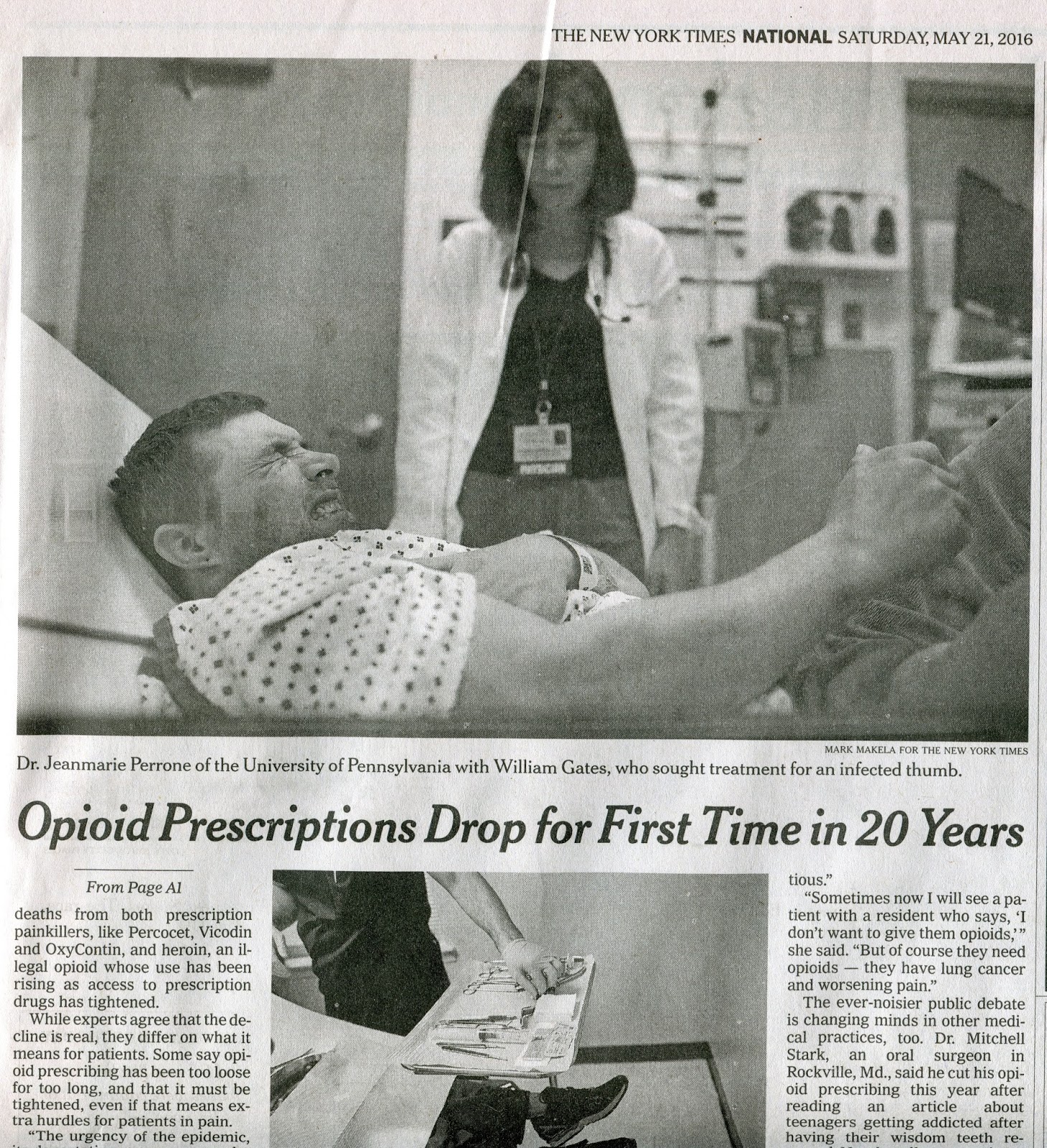
Opioid Prescriptions Down; Deaths Up, NY Times reports


http://www.nytimes.com/2016/05/21/health/opioid-prescriptions-drop-for-first-time-in-two-decades.html?_r=0
(excerpts)
"...for each of the past three years — 2013, 2014 and 2015 — prescriptions have declined, a review of several sources of data shows."

" IMS Health, an information firm whose data on prescribing is used throughout the health care industry, found a 12 percent decline in opioid prescriptions nationally since a peak in 2012. Another data company, Symphony Health Solutions, reported a drop of about 18 percent during those years. Opioid prescriptions have fallen in 49 states since 2013, according to IMS, with some of the sharpest decreases coming in West Virginia, the state considered the center of the opioid epidemic, and in Texas and Oklahoma. (Only South Dakota showed an increase.)" ...
... One important development that may have helped propel the decline came in 2014, when the federal government tightened prescribing rules for one of the most common painkillers: hydrocodone combined with a second analgesic, like acetaminophen. In the first year after the measure took effect, dispensed prescriptions declined by 22 percent, and pills by 16 percent, according to an analysis in JAMA Internal Medicine. Refills — which the change made much more difficult — accounted for 73 percent of the decline.

Yet:
" So far, fewer prescriptions have not led to fewer deaths: fatal overdoses from opioids have continued to rise, taking more than 28,000 lives in 2014, according to the most recent federal health data. That number includes deaths from both prescription painkillers, like Percocet, Vicodin and OxyContin, and heroin, an illegal opioid whose use has been rising as access to prescription drugs has tightened."

The NY Times article reports this has led to a controversy. 
While experts agree that the decline is real, they differ on what it means for patients. Some say opioid prescribing has been too loose for too long, and that it must be tightened, even if that means extra hurdles for patients in pain.

“The urgency of the epidemic, its devastating consequences, demands interventions that in some instances may make it harder for some patients to get their medication,” said Dr. Nora Volkow, the director of the National Institute on Drug Abuse. “We need to set up a system to make sure they are covered. But we cannot continue the prescription practice of opioids the way we have been. We just can’t.”

Others argue that efforts to rein in prescribing have gone too far and are penalizing patients who take the medicines responsibly and need them for relief.
Indeed, such efforts have led to a growing fear among doctors to prescribe opioids in general.
“The climate has definitely shifted,” said Dr. Daniel B. Carr, the director of Tufts Medical School’s program on pain research education and policy. “It is now one of reluctance, fear of consequences and encumbrance with administrative hurdles. A lot of patients who are appropriate candidates for opioids have been caught up in that response.”...
... Dr. Mitchell Stark, an oral surgeon in Rockville, Md., said he cut his opioid prescribing this year after reading an article about teenagers getting addicted after having their wisdom teeth removed. Now he tells even patients recovering from multiple extractions to try prescription-strength ibuprofen first.
“I don’t want to be the person who gets a call from someone saying, ‘My kid had an overdose with the Vicodin he had left from getting his wisdom teeth out,’” Dr. Stark said.
Yet further restricting prescriptions for opioids has led to other worsening problems.
Many experts say that the drop in prescribing is at best a half victory, in light of the rise of deaths from heroin and illicit fentanyl, a powerful synthetic painkiller. Some addicts who started with prescription painkillers are merely turning to such street drugs or getting their hands on prescription drugs by other means.

“We are seeing, in our area, many more pharmacies being robbed,” said Dr. Richard Vaglienti, the director of outpatient pain services at WVU Medicine, a health system in West Virginia.

Interestingly, these policies relay heavily upon lumping different matters together.

Different types of users.

And especially, different types of opioids in general, particularly the lumping together of pills which are of known predictable potency, with black market 'heroin' of vastly variable potency, and even adulterated with far far stronger opioids as fentanyl.

It is as if they view predictability of potency almost irrelevant.

Let alone  the type of user.  Such as those who take relatively modest doses, versus those that massively escalate their doses, especially those who instead take them not orally by mouth as intended, but those who grind them up to sniff them or to dissolve in a solution to be injected.

The May 21, 2016 NY Times article does not delve into any of this, including neglecting to mention that escalation to serious physical addiction via overuse-abuse is confined to a small minority of prescription receivers.  In other words, punish most consumers for the actions of a small minority, never-mind that such would be seen as insane if for instance applied to consumers of alcoholic beverages (despite alcohol actually being far more potentially toxic than opioids!!!).

Nor does it delve into the matter qualitatively, by choosing to focus simply quantitatively upon the number of prescriptions and pills for such issued.  Though it quotes NIDA's Nora Volkow as saying that "... we cannot continue the prescription practice of opioids the way we have been. We just can’t...", the article simply fails at any analysis that is qualitative rather than quantitative.  For instance, failing to ask such questions as:


- why prescribing doctors insist that opioids be taken regularly rather than more infrequently.

- why they must only be made available in far more easily abuse-able concentrated forms.


Educating people on how to use and how not to uses opioids would reduce problems as overdoses.  Such as do not take too frequently, nor escalate the dosage to compensate for tolerance, nor mix with certain other drugs, as many fatal overdoses involve such, rather than an opioid alone.

Making opioids available in safer forms, such as those more dilute and perhaps not very tasty would likewise discourage overuse.

Likewise, the availability of products to occasionally 're-set' one's level of tolerance, such as with Iboga-Ibogaine, as an alternative to more synthetic forms of opioids as methadone and buprenorphine that require regular use and may be more physically addictive than the opioid they are used to replace.

Education, combined with safer forms would serve to counterbalance making opioids more available, while undercutting the black market.

Current policies to not educate people, to increase doses, to provide only in abuse-able concentrated forms, and to encourage continued use via such highly questionable more recent practices as drug testing patients to ensure they are taking their opioids frequently, and cutting off such prescriptions, all serve to steer people towards black market heroin.

Even reforming the prescription system to allow metered, rationed refills over longer periods of time, based upon a patient's needs -- aka injuries -- would be a step in the right direction.   Since many people have suffered like injuries, why has not the medical profession developed a guide for such a rationing, at least for lower doses?  Indeed, why has the medical profession so tolerated a government meddling in medical prescribing since 1915, so lacking in any concrete definitions of "professional [medical] practice", since the initial 1914 U.S. Harrison Act's delegation of regulatory authority to the U.S. Department of Treasury?!

If the State of Montana's "reasonable and prudent" speed limit could be struck down as unconstitutionally vague, how about the entire regulatory meddling in opioid availability?

Why is the medical profession generally so complacent?

Why do they not challenge such policies?

Because current policies are designed primarily to increase costs and thus profits.

Reforming opioid availability would reduce the need for separate visits to a doctor for each refill.

More dilute forms of opioids to displace pills would mean less profit per shelf space.

More alternatives, particularly those for reversing tolerance, would undercut the "treatment" industry empire, including that of methadone, buprenorphin, all requiring separate visits to doctors, let alone the cultivated guilt placed upon addicts to opioids dissimilar to those of say nicotine.

Thus they choose to blur together different types of users, along with different general types of opioids- aka measured dosage pills with variable strength 'heroin, to actually undermine health, including by undermining efforts to provide safer legal forms of opioids to consumers- never-mind that opioids are arguably far far less toxic than the abuse of alcohol let alone the regular use of mass marketed Tobacco.

For what they are doing is part of a political agenda, to maintain a set of policies set in place during the early 1900s- which includes the "great" drug war, as part of a broader agenda of centralized control over the fields of medicine and diet.

One that was sold to the public as a means of serving their health, but in fact subvert such by interfering with markets to reduce choice for the benefit of those interests that saw and used such means to protect and advance their own markets via criminalizing their competitors.

From the numbers of medical schools and health care providers- aka the American Medical Association/Flexner Report.

To the types of drugs in use, via a process of elimination favoring not what was necessarily safer, or more effective, but rather what was more potentially profitable if not better established.

As with any propaganda campaign designed to deceive, that which brought this agenda about had its share of terms used to confuse the general public.  "Patent Medicines" in fact would be those that would be patented as they were man-made rather than natural creations- aka pharmaceuticals rather than herbs, plants found in nature.  Yet that term would be flung at what were actually "proprietary" medicines -- trademarked names upon man-made mixtures of natural substances as extracts of herbs, which could not themselves be patented and thus could not be monopolized, and which were generally preparations- products that were dilute liquids intended to be drank, and hence far bulkier than highly concentrated powders and pills.  Hence, scaring people away from un-patentable herbs and bulky liquid medicinal products meant using such prerogatives as "nostrums" and 'quackery".  And such a disfo campaign, as that promoted in the ironically named "The Great American Fraud" article series in Colliers Magazine authored by the 'muckracker' Samuel Adams Hopkins in collaboration with U.S.D.A Bureau of Chemistry Chief Harvey Washington Wiley (who also served with the American Medical Association-American Pharmaceutical Association), would rely heavily upon confusing the potential dangers of highly concentrated derivatives as morphine and cocaine in powder forms with the parent substances of Opium and Coca, with an utter disregard of dosage matters of potency and route of administration.

As could be expected with such a deceptive campaign, it was used to achieve passage of the U.S. Foods and Drugs Act of 1906, that, though not outright prohibiting any substance, would be the steeping stone to prohibition.  Ostensibly, it mainly required the labeling of the amount of certain substances in food and drug products; yet, the 1906 Act would grant dictatorial power to Wiley's U.S.D.A. Chemistry Bureau to prohibit from interstate commerce any product containing a substance which he/it deemed 'dangerous' or 'deleterious to human health' - without any required scientific backing!   Though the Act would for instance include cocaine as a substance required to be labeled, Wiley's Bureau wasted little time in prosecuting beverage manufacturers for "adulteration" for containing a supposedly dangerous and deleterious ingredient, with absolutely no showing of any actual harms to health for the relatively low concentrations of cocaine present, generally 1/2 to 3 milligrams per fluid ounce, and never-mind the implied legality via cocaine's inclusion within the labeling requirement list not only for products sold as medicines but as well as those sold as foods (aka more frequent use).  The subsequent push to eliminate cocaine, irregardless of how dilute and harmless the amount, from commercial products, including those sold as medicines, came with the legislative campaign to limit such products to prescription use only, and make such prescriptions non-refillable.  Such was what brought about the U.S. Harrison 'Narcotics' Act of 1914.  Though that Act would still allow over the counter sales of lower potency opiate preparations containing under  "two grains of opium, or more than one-fourth of a grain of morphine, or more than one-eighth of a grain of heroin . in one avoirdupois ounce", it made no such allowances for cocaine, regardless of how low the amount.

As should be expected from such a deception, this campaign was not about reducing addiction nor serving the public health.

It grossly confused Opium and Coca with highly concentrated forms of opiates and cocaine, thus rendering any such remaining popular use of such substances in their most dangerous forms, owing to the dynamics of prohibition 's iron law of shifting availability to ultra concentrated forms.

Though it arguably reduced the total size of the drug using population of opiates and cocaine, it hardly reduced the overall size of the population of people who used drugs as it served to protect and promote other competing drugs- particularly mass marketed Tobacco.

Such were more physically addictive than even heroin, and far deadlier from chronic use.

That latter fact can be true regarding non opioid pain killers, as Tylenol with their ill effects upon the liver.

Yet one would not likily realize this from the relative official attitudes towards these different classes of substances.

See also:


http://freedomofmedicineanddiet.blogspot.com/2016/03/more-reporting-should-be-done-on-lives.html

http://freedomofmedicineanddiet.blogspot.com/2016/02/how-about-methadone-model-for-nicotine.html


Monday, March 28, 2016

More reporting should be done on the lives saved and enhanced by opioids, addressing chronic pain, sleep disorders and associated depression.


http://www.nytimes.com/2016/03/27/opinion/sunday/opioid-use-and-abuse.html?_r=0

To the Editor: Re “A Strong Response to the Opioid Scourge” (editorial, March 17):

There are longtime users of low-dose opioids, like me, who never require an increase in dose and who find that this medication provides quality of life. How? By addressing chronic pain, sleep disorders and associated depression.

The alternatives proposed by the Centers for Disease Control and Prevention, like aspirin and ibuprofen, can cause long-term damage to body organs and short-term stomach pain. For many of us, spare use of a low-dose opioid is the very best alternative.

Unfortunately, voices like mine are not heard often. Why? Because the media climate right now is so fiercely anti-opioid that those who rely on this drug can feel hesitant to speak out. More reporting should be done on the lives saved and enhanced by opioids, in addition to the terrible consequences of addiction. Policy should reflect a more complete picture of this important medication.

KATHERINE CAMERON
Alameda, Calif.
The writer is a social worker.


To the Editor: The proper treatment of pain disorders by physicians should not be directed by the fear of lawsuits or pressure by insurance payers but rather by sound guidelines developed by organizations like the American Academy of Pain Medicine.

The news media has readily noted a “prescription drug epidemic,” but overdoses mainly result from drug diversion and misuse rather than from taking an opioid as prescribed. Epidemiological data has reported up to 16,500 deaths a year from the aspirin-ibuprofen family of medicines, which can cause ulcers, kidney failure and liver inflammation, none of which occur with opioids.

The major health issue for an opioid is addiction, which rarely occurs in a properly selected and treated patient. One must understand the difference between dependency and addiction.

Chronic, nonmalignant pain conditions are difficult to treat. Physician judgment is crucial and should not be inhibited by arbitrary limits that are not supported by the data.

LESLIE SCHOFFERMAN
San Francisco
The writer is a pain doctor.


To the Editor: For many people with chronic pain, opioid painkillers are a lifeline. The new guidelines from the Centers for Disease Control and Prevention, while perhaps reasonable as a first approach, are unrealistic for patients who have done well (sometimes for years) on carefully monitored opioid doses under continuing medical care. As The Times has reported, these longtime patients must now be subjected to humiliating “pain contracts” and random drug tests.

Acetaminophen and ibuprofen are just short of laughable: If they worked for severe pain, no legitimate patient would be taking opioids. Nonpharmacological solutions like physical therapy and acupuncture may be effective for those who can afford them but are subject to strict, onerous insurance limitations or not covered at all.

It’s hard not to conclude that the politics of the very real and tragic opioid addiction crisis are drowning out the cries of people in pain. The medical profession only recently began to give serious attention to complaints of chronic pain, which not incidentally affects many more women than men.

Sadly, it looks as if a return to the bad old days will be upon us very soon.

LOIS AMBASH
Needham, Mass.

Friday, February 26, 2016

Trump To Increase Opiate Deaths By Further Popularizing DOMESTIC Fentanyl

by building a wall with the said goal to stop contraband drugs as his response to heroin


The "success" of this sort of policy would be to favor domestically produced bathtub "heroin" that would be likely spiked with the far more potent synthetic opiate fentanyl, in of course vastly varying potencies, unregulated thus promoting even more fatal ODs.

By banning Opium and its derivatives, the market availability was shifted to the more concentrated forms of opiates as Heroin HCI, and with the price likewise artificially increased to be pricier per weight than gold, encouraged its use in the way with the greatest 'bang for the buck" of injection- also the most addictive and potentially dangerous- further exacerbated by the variable potency of such a substance in an unregulated black market of uncertain purity and adulteration perhaps with something even stronger such as fentanyl.

By failing to address any of this Trump shows that he fails to understand basic economics, that he would rather pander to stupidity by supporting the very polices making the problem far far worse, that he would fail to even attempt to explain that, and that he is a shill for the powers that be that gave us this mess over a century ago.