Pages

Showing posts with label Pharmacratic Inquisition. Show all posts

Thursday, June 9, 2016

End Opioid Prohibition

The media hysterics against opioids, such as The New York Times, ought to be ashamed of themselves!

http://www.theguardian.com/us-news/commentisfree/2016/jun/08/opioid-epidemic-drug-mix-overdose-death

Bob Bee- It's prohibition that serves to ensure opioids are more dangerous than they otherwise would be, due to uncertainty of purity and dosage of unregulated, black market drugs. Thus prohibition makes fatal OD's more likely, not less. Opioids should be legalized, regulated, and taxed like tobacco and alcohol. That way, users would know exactly what they were buying and the dosage. Also, opioid legalization would mean good, old, natural opium would be legally available. Users could opt for opium (active ingredients include morphine & codeine. It can be eaten, smoked, or consumed as a tea) as a safer alternative to ultra-potent pharma-junk powders & pills. Opium's safer as it's less concentrated and is harder to fatally OD on. End the counter-productive, hypocritical, unjust, indefensible war on opioids.


http://freedomofmedicineanddiet.blogspot.com/2016/05/opioid-prescriptions-down-deaths-up-ny.html

Friday, May 27, 2016

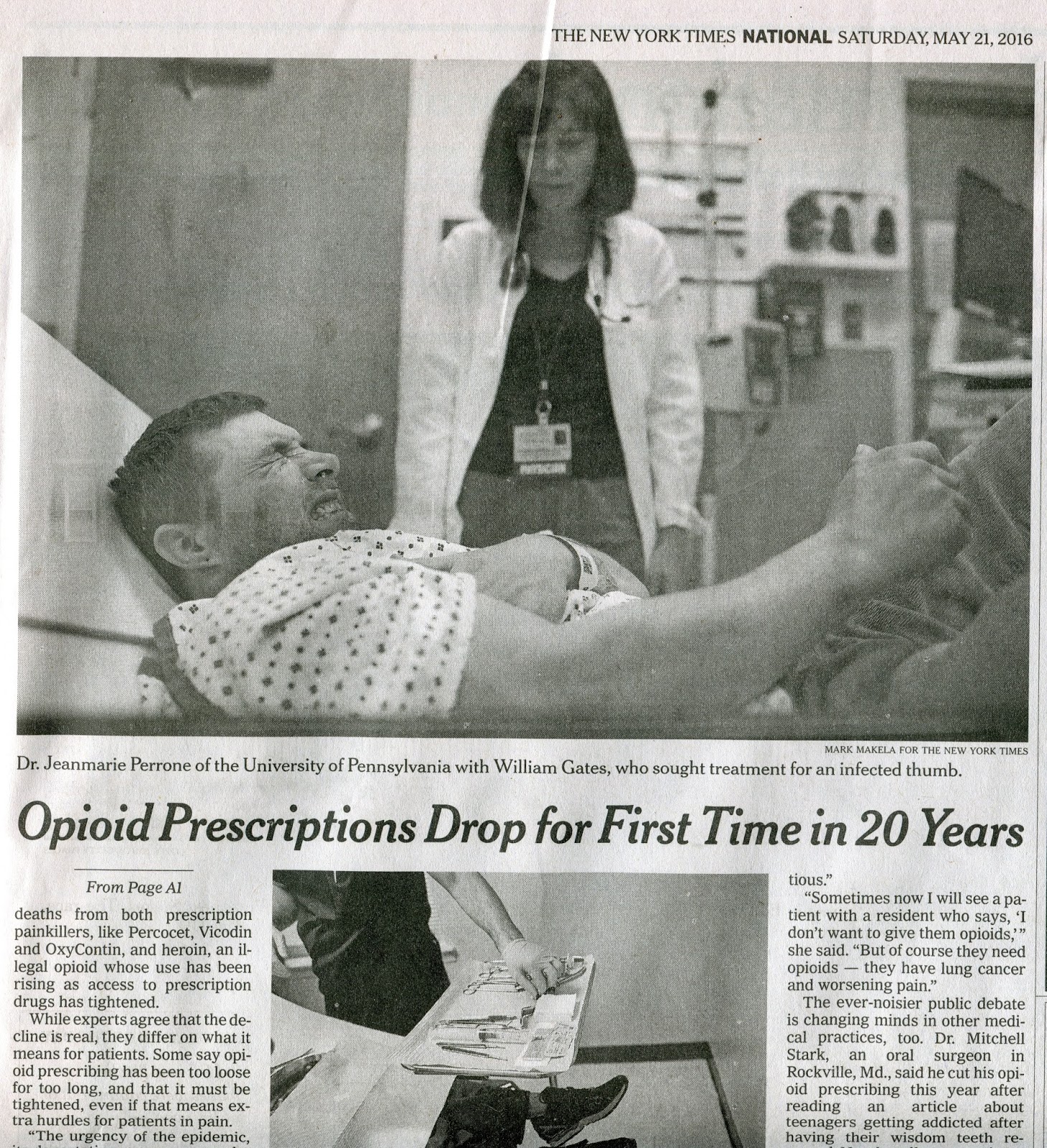
Opioid Prescriptions Down; Deaths Up, NY Times reports


http://www.nytimes.com/2016/05/21/health/opioid-prescriptions-drop-for-first-time-in-two-decades.html?_r=0
(excerpts)
"...for each of the past three years — 2013, 2014 and 2015 — prescriptions have declined, a review of several sources of data shows."

" IMS Health, an information firm whose data on prescribing is used throughout the health care industry, found a 12 percent decline in opioid prescriptions nationally since a peak in 2012. Another data company, Symphony Health Solutions, reported a drop of about 18 percent during those years. Opioid prescriptions have fallen in 49 states since 2013, according to IMS, with some of the sharpest decreases coming in West Virginia, the state considered the center of the opioid epidemic, and in Texas and Oklahoma. (Only South Dakota showed an increase.)" ...
... One important development that may have helped propel the decline came in 2014, when the federal government tightened prescribing rules for one of the most common painkillers: hydrocodone combined with a second analgesic, like acetaminophen. In the first year after the measure took effect, dispensed prescriptions declined by 22 percent, and pills by 16 percent, according to an analysis in JAMA Internal Medicine. Refills — which the change made much more difficult — accounted for 73 percent of the decline.

Yet:
" So far, fewer prescriptions have not led to fewer deaths: fatal overdoses from opioids have continued to rise, taking more than 28,000 lives in 2014, according to the most recent federal health data. That number includes deaths from both prescription painkillers, like Percocet, Vicodin and OxyContin, and heroin, an illegal opioid whose use has been rising as access to prescription drugs has tightened."

The NY Times article reports this has led to a controversy. 
While experts agree that the decline is real, they differ on what it means for patients. Some say opioid prescribing has been too loose for too long, and that it must be tightened, even if that means extra hurdles for patients in pain.

“The urgency of the epidemic, its devastating consequences, demands interventions that in some instances may make it harder for some patients to get their medication,” said Dr. Nora Volkow, the director of the National Institute on Drug Abuse. “We need to set up a system to make sure they are covered. But we cannot continue the prescription practice of opioids the way we have been. We just can’t.”

Others argue that efforts to rein in prescribing have gone too far and are penalizing patients who take the medicines responsibly and need them for relief.
Indeed, such efforts have led to a growing fear among doctors to prescribe opioids in general.
“The climate has definitely shifted,” said Dr. Daniel B. Carr, the director of Tufts Medical School’s program on pain research education and policy. “It is now one of reluctance, fear of consequences and encumbrance with administrative hurdles. A lot of patients who are appropriate candidates for opioids have been caught up in that response.”...
... Dr. Mitchell Stark, an oral surgeon in Rockville, Md., said he cut his opioid prescribing this year after reading an article about teenagers getting addicted after having their wisdom teeth removed. Now he tells even patients recovering from multiple extractions to try prescription-strength ibuprofen first.
“I don’t want to be the person who gets a call from someone saying, ‘My kid had an overdose with the Vicodin he had left from getting his wisdom teeth out,’” Dr. Stark said.
Yet further restricting prescriptions for opioids has led to other worsening problems.
Many experts say that the drop in prescribing is at best a half victory, in light of the rise of deaths from heroin and illicit fentanyl, a powerful synthetic painkiller. Some addicts who started with prescription painkillers are merely turning to such street drugs or getting their hands on prescription drugs by other means.

“We are seeing, in our area, many more pharmacies being robbed,” said Dr. Richard Vaglienti, the director of outpatient pain services at WVU Medicine, a health system in West Virginia.

Interestingly, these policies relay heavily upon lumping different matters together.

Different types of users.

And especially, different types of opioids in general, particularly the lumping together of pills which are of known predictable potency, with black market 'heroin' of vastly variable potency, and even adulterated with far far stronger opioids as fentanyl.

It is as if they view predictability of potency almost irrelevant.

Let alone  the type of user.  Such as those who take relatively modest doses, versus those that massively escalate their doses, especially those who instead take them not orally by mouth as intended, but those who grind them up to sniff them or to dissolve in a solution to be injected.

The May 21, 2016 NY Times article does not delve into any of this, including neglecting to mention that escalation to serious physical addiction via overuse-abuse is confined to a small minority of prescription receivers.  In other words, punish most consumers for the actions of a small minority, never-mind that such would be seen as insane if for instance applied to consumers of alcoholic beverages (despite alcohol actually being far more potentially toxic than opioids!!!).

Nor does it delve into the matter qualitatively, by choosing to focus simply quantitatively upon the number of prescriptions and pills for such issued.  Though it quotes NIDA's Nora Volkow as saying that "... we cannot continue the prescription practice of opioids the way we have been. We just can’t...", the article simply fails at any analysis that is qualitative rather than quantitative.  For instance, failing to ask such questions as:


- why prescribing doctors insist that opioids be taken regularly rather than more infrequently.

- why they must only be made available in far more easily abuse-able concentrated forms.


Educating people on how to use and how not to uses opioids would reduce problems as overdoses.  Such as do not take too frequently, nor escalate the dosage to compensate for tolerance, nor mix with certain other drugs, as many fatal overdoses involve such, rather than an opioid alone.

Making opioids available in safer forms, such as those more dilute and perhaps not very tasty would likewise discourage overuse.

Likewise, the availability of products to occasionally 're-set' one's level of tolerance, such as with Iboga-Ibogaine, as an alternative to more synthetic forms of opioids as methadone and buprenorphine that require regular use and may be more physically addictive than the opioid they are used to replace.

Education, combined with safer forms would serve to counterbalance making opioids more available, while undercutting the black market.

Current policies to not educate people, to increase doses, to provide only in abuse-able concentrated forms, and to encourage continued use via such highly questionable more recent practices as drug testing patients to ensure they are taking their opioids frequently, and cutting off such prescriptions, all serve to steer people towards black market heroin.

Even reforming the prescription system to allow metered, rationed refills over longer periods of time, based upon a patient's needs -- aka injuries -- would be a step in the right direction.   Since many people have suffered like injuries, why has not the medical profession developed a guide for such a rationing, at least for lower doses?  Indeed, why has the medical profession so tolerated a government meddling in medical prescribing since 1915, so lacking in any concrete definitions of "professional [medical] practice", since the initial 1914 U.S. Harrison Act's delegation of regulatory authority to the U.S. Department of Treasury?!

If the State of Montana's "reasonable and prudent" speed limit could be struck down as unconstitutionally vague, how about the entire regulatory meddling in opioid availability?

Why is the medical profession generally so complacent?

Why do they not challenge such policies?

Because current policies are designed primarily to increase costs and thus profits.

Reforming opioid availability would reduce the need for separate visits to a doctor for each refill.

More dilute forms of opioids to displace pills would mean less profit per shelf space.

More alternatives, particularly those for reversing tolerance, would undercut the "treatment" industry empire, including that of methadone, buprenorphin, all requiring separate visits to doctors, let alone the cultivated guilt placed upon addicts to opioids dissimilar to those of say nicotine.

Thus they choose to blur together different types of users, along with different general types of opioids- aka measured dosage pills with variable strength 'heroin, to actually undermine health, including by undermining efforts to provide safer legal forms of opioids to consumers- never-mind that opioids are arguably far far less toxic than the abuse of alcohol let alone the regular use of mass marketed Tobacco.

For what they are doing is part of a political agenda, to maintain a set of policies set in place during the early 1900s- which includes the "great" drug war, as part of a broader agenda of centralized control over the fields of medicine and diet.

One that was sold to the public as a means of serving their health, but in fact subvert such by interfering with markets to reduce choice for the benefit of those interests that saw and used such means to protect and advance their own markets via criminalizing their competitors.

From the numbers of medical schools and health care providers- aka the American Medical Association/Flexner Report.

To the types of drugs in use, via a process of elimination favoring not what was necessarily safer, or more effective, but rather what was more potentially profitable if not better established.

As with any propaganda campaign designed to deceive, that which brought this agenda about had its share of terms used to confuse the general public.  "Patent Medicines" in fact would be those that would be patented as they were man-made rather than natural creations- aka pharmaceuticals rather than herbs, plants found in nature.  Yet that term would be flung at what were actually "proprietary" medicines -- trademarked names upon man-made mixtures of natural substances as extracts of herbs, which could not themselves be patented and thus could not be monopolized, and which were generally preparations- products that were dilute liquids intended to be drank, and hence far bulkier than highly concentrated powders and pills.  Hence, scaring people away from un-patentable herbs and bulky liquid medicinal products meant using such prerogatives as "nostrums" and 'quackery".  And such a disfo campaign, as that promoted in the ironically named "The Great American Fraud" article series in Colliers Magazine authored by the 'muckracker' Samuel Adams Hopkins in collaboration with U.S.D.A Bureau of Chemistry Chief Harvey Washington Wiley (who also served with the American Medical Association-American Pharmaceutical Association), would rely heavily upon confusing the potential dangers of highly concentrated derivatives as morphine and cocaine in powder forms with the parent substances of Opium and Coca, with an utter disregard of dosage matters of potency and route of administration.

As could be expected with such a deceptive campaign, it was used to achieve passage of the U.S. Foods and Drugs Act of 1906, that, though not outright prohibiting any substance, would be the steeping stone to prohibition.  Ostensibly, it mainly required the labeling of the amount of certain substances in food and drug products; yet, the 1906 Act would grant dictatorial power to Wiley's U.S.D.A. Chemistry Bureau to prohibit from interstate commerce any product containing a substance which he/it deemed 'dangerous' or 'deleterious to human health' - without any required scientific backing!   Though the Act would for instance include cocaine as a substance required to be labeled, Wiley's Bureau wasted little time in prosecuting beverage manufacturers for "adulteration" for containing a supposedly dangerous and deleterious ingredient, with absolutely no showing of any actual harms to health for the relatively low concentrations of cocaine present, generally 1/2 to 3 milligrams per fluid ounce, and never-mind the implied legality via cocaine's inclusion within the labeling requirement list not only for products sold as medicines but as well as those sold as foods (aka more frequent use).  The subsequent push to eliminate cocaine, irregardless of how dilute and harmless the amount, from commercial products, including those sold as medicines, came with the legislative campaign to limit such products to prescription use only, and make such prescriptions non-refillable.  Such was what brought about the U.S. Harrison 'Narcotics' Act of 1914.  Though that Act would still allow over the counter sales of lower potency opiate preparations containing under  "two grains of opium, or more than one-fourth of a grain of morphine, or more than one-eighth of a grain of heroin . in one avoirdupois ounce", it made no such allowances for cocaine, regardless of how low the amount.

As should be expected from such a deception, this campaign was not about reducing addiction nor serving the public health.

It grossly confused Opium and Coca with highly concentrated forms of opiates and cocaine, thus rendering any such remaining popular use of such substances in their most dangerous forms, owing to the dynamics of prohibition 's iron law of shifting availability to ultra concentrated forms.

Though it arguably reduced the total size of the drug using population of opiates and cocaine, it hardly reduced the overall size of the population of people who used drugs as it served to protect and promote other competing drugs- particularly mass marketed Tobacco.

Such were more physically addictive than even heroin, and far deadlier from chronic use.

That latter fact can be true regarding non opioid pain killers, as Tylenol with their ill effects upon the liver.

Yet one would not likily realize this from the relative official attitudes towards these different classes of substances.

See also:


http://freedomofmedicineanddiet.blogspot.com/2016/03/more-reporting-should-be-done-on-lives.html

http://freedomofmedicineanddiet.blogspot.com/2016/02/how-about-methadone-model-for-nicotine.html


Tuesday, May 24, 2016

Trump To Accept Funding Via 'Straight' Drug War Fanatic Mel Sembler


Trump has abandoned his earlier idea of being self-funded.
http://www.newsmax.com/Politics/US-GOP-2016-Trump-Money/2016/05/24/id/730470/?ns_mail_uid=7499169&ns_mail_job=1669680_05242016&s=al&dkt_nbr=tiwkw91r

Trump and the RNC on Tuesday announced new additions to the financial operation, including New York Jets owner Woody Johnson, roofing company owner Diane Hendricks and former Ambassador Mel Sembler, who helped raise major money for previous presidential candidates.
About Mel Sembler's assault on freedom of medicine and diet, particularly Cannabis.

https://en.wikipedia.org/wiki/Mel_Sembler

In 1976, Sembler and his wife Betty founded Straight, Inc., an adolescent drug treatment program which has treated more than 12,000 addicts. The group now operates as the Drug Free America Foundation.[18]
In May 1983, Straight, Inc was convicted of false imprisonment after being sued by then 20-year-old Fred Collins Jr, who alleged he had been held captive by the program against his will. The program was ordered to pay $40,000 in compensatory and $180,000 in punitive damages.[19][20]

In 1990, a jury awarded Karen Norton $721,000 in damages due to mistreatment by Straight. In 1982, while a patient in Straight's Florida facility, Norton alleged that staff members assaulted her, and denied her health care.[21]

It has been suggested that licensing for Straight's Florida-based programs had been renewed under pressure from Sembler on state senators.[22]

Sembler's Drug Free America Foundation continues to campaign for hard-line drug policy. Former Governor Jeb Bush of Florida, the brother of President George W. Bush, Former Drug Enforcement Administration Administrator Karen Tandy, and Congressman Dan Lungren of California are on the advisory board.[23]

Monday, March 28, 2016

More reporting should be done on the lives saved and enhanced by opioids, addressing chronic pain, sleep disorders and associated depression.


http://www.nytimes.com/2016/03/27/opinion/sunday/opioid-use-and-abuse.html?_r=0

To the Editor: Re “A Strong Response to the Opioid Scourge” (editorial, March 17):

There are longtime users of low-dose opioids, like me, who never require an increase in dose and who find that this medication provides quality of life. How? By addressing chronic pain, sleep disorders and associated depression.

The alternatives proposed by the Centers for Disease Control and Prevention, like aspirin and ibuprofen, can cause long-term damage to body organs and short-term stomach pain. For many of us, spare use of a low-dose opioid is the very best alternative.

Unfortunately, voices like mine are not heard often. Why? Because the media climate right now is so fiercely anti-opioid that those who rely on this drug can feel hesitant to speak out. More reporting should be done on the lives saved and enhanced by opioids, in addition to the terrible consequences of addiction. Policy should reflect a more complete picture of this important medication.

KATHERINE CAMERON
Alameda, Calif.
The writer is a social worker.


To the Editor: The proper treatment of pain disorders by physicians should not be directed by the fear of lawsuits or pressure by insurance payers but rather by sound guidelines developed by organizations like the American Academy of Pain Medicine.

The news media has readily noted a “prescription drug epidemic,” but overdoses mainly result from drug diversion and misuse rather than from taking an opioid as prescribed. Epidemiological data has reported up to 16,500 deaths a year from the aspirin-ibuprofen family of medicines, which can cause ulcers, kidney failure and liver inflammation, none of which occur with opioids.

The major health issue for an opioid is addiction, which rarely occurs in a properly selected and treated patient. One must understand the difference between dependency and addiction.

Chronic, nonmalignant pain conditions are difficult to treat. Physician judgment is crucial and should not be inhibited by arbitrary limits that are not supported by the data.

LESLIE SCHOFFERMAN
San Francisco
The writer is a pain doctor.


To the Editor: For many people with chronic pain, opioid painkillers are a lifeline. The new guidelines from the Centers for Disease Control and Prevention, while perhaps reasonable as a first approach, are unrealistic for patients who have done well (sometimes for years) on carefully monitored opioid doses under continuing medical care. As The Times has reported, these longtime patients must now be subjected to humiliating “pain contracts” and random drug tests.

Acetaminophen and ibuprofen are just short of laughable: If they worked for severe pain, no legitimate patient would be taking opioids. Nonpharmacological solutions like physical therapy and acupuncture may be effective for those who can afford them but are subject to strict, onerous insurance limitations or not covered at all.

It’s hard not to conclude that the politics of the very real and tragic opioid addiction crisis are drowning out the cries of people in pain. The medical profession only recently began to give serious attention to complaints of chronic pain, which not incidentally affects many more women than men.

Sadly, it looks as if a return to the bad old days will be upon us very soon.

LOIS AMBASH
Needham, Mass.

Thursday, November 12, 2015

Nadelmann IGNORES Economic Reasons- Focusing Exclusively Upon Racism

ZERO mention of market-control mercantilism of the war to protect Tobacco cigarettes and synthetic pharmaceuticals

Focuses EXCLUSIVELY upon racism as fears of Chinese Opium smokers and Black cocaine sniffers respectively in the western and south-eastern United States of America

http://www.upworthy.com/i-thought-we-banned-cocaine-for-health-reasons-nope-not-even-close?g=2&c=ufb1


Sunday, February 15, 2015

The AMA Needs To be Sued For Criminal Racketeering- Ripping Off The Public


Supports the 'drug war' perversion of useful natural substances into concentrated poisons, lying through their teeth about Cannabis, and the massive violations of human rights for its criminal mercantilism on behalf of synthetic patentable chemical quackery

Medical Control, Medical Corruption
By Llewellyn H. Rockwell Jr.

http://www.lewrockwell.com/1970/01/lew-rockwell/medical-control-medical-corruption/

This article appeared in the June 1994 issue of Chronicles.

The vested interests are sick over it: Americans are beginning, just slightly, to take charge of their own health care. Such best-sellers as the Doctor’s Book of Home Remedies, the Physician’s Desk Reference, and the Merck Manual can keep you out of the doctor’s appropriately named waiting room, or at least help you understand what is being done to you, when an apple a day does not work.

Who is unhappy with this increased knowledge? The American Medical Association, which for almost 150 years has sought to institutionalize a rip-off and to keep sick people and their families oblivious to it. Thanks to this central committee of the medical cartel, the number of medical schools and medical students is drastically restricted, state licensure further obstructs the supply of doctors, fees are largely secret and controlled across the industry, alternative treatments and practitioners are outlawed, pharmacists and nurses are hamstrung, and the mystique of the profession rivals the priesthood, although priests have a somewhat lower income. Meanwhile, the customer pays through the nose, even if he does not go to an otolaryngologist.

Medicaid and Medicare have contributed to the problem, but the medical cartel is the original sin. Through its ability to keep incomes high by limiting supply and outlawing competition, organized medicine has punished its customers, although the word is never used so as to disguise what is, after all, an economic relationship.

Hillary Clinton’s proposed merger of the medical cartel and the state seems like a radical move, and it is. It is also the logical next step in the partnership of government and medicine. That is why, in addition to opposing Hillary hammer and tongs, we should reexamine the AMA’s distortion of the medical marketplace and the very idea of medical licensure.

Competition among providers — as with any service in a market economy — leads to rational pricing and maximum consumer choice. But this is exactly what the AMA has always sought to prevent. The American Medical Association, organized in New York in 1848, advanced two seemingly innocent propositions in its early days: that all doctors should have a “suitable education” and that a “uniform elevated standard of requirements for the degree of M.D. should be adopted by all medical schools in the U.S.” These were part of the AMA’s real program, which was openly discussed at its conventions and in the medical journals: to secure a government-enforced medical monopoly and high incomes for mainstream doctors.

Membership in the new organization was open only to “regular” physicians, whose therapies were based on the “best system of physiology and pathology, as taught in the best schools in Europe and America.” The public had a different view, however. Official treatments of the time, such as bloodletting and mercury poisoning, harmed and sometimes murdered patients, causing mass outrage.

Emphatically not included among the “best” were the homeopaths. Homeopathy, a less invasive system that still thrives in Britain and Europe, may have done no good, but that was the worst charge lodged against it. Homeopathy did not kill people, as Orthodox medicine did. The homeopaths actually followed the Hippocratic injunction “First, do not harm” and refused to worship abstract Science. As a result, the clergy — an important interest group in 19th-century America — sympathized with them. As the president of the New York State Medical Society noted in 1844, “We feel severely the influence of the clergy as operating against our collective interest.” One prominent pastor, for example, had called the medical establishment “an expensive vampire upon society.”
How the “regulars” came to crush the homeopaths and other competitors, and penalize patients in the process, is a story of deception and manipulation, of industry self-interest and state power. The organized regulars or allopaths first set out to demonstrate that the homeopaths were ill-educated and therefore should be shunned, but that was difficult to substantiate because most of them were converts from orthodox medicine.

One was William H. Holcombe. When he graduated from the University of Pennsylvania, he worried, as he wrote in his memoirs, that physicians “were blind men, striking in the dark at the disease or the patient-lucky if [we] killed the malady [instead of] the man.” One day Holcombe was called by the parents of a seriously ill child, whom Holcombe subsequently set about to bleed. Bloodletting was considered especially important for children, and the younger the child, the more blood was to be drawn. But the mother clutched the baby to her breast and cried, “The blood is the life — it shall not be taken away.” When the benighted father agreed, Holcombe “explained to him candidly, and with some display of professional dignity, that my opinion was worth more than his or his wife’s.”

Holcombe left and returned the next day, expecting to find a dead baby. Instead, the child — who had been treated by a homeopath — was playing in the yard. Holcombe later wrote that “after having blistered, bled, and drugged my patients for twenty-seven years, I determined to find some more humane mode.” He was charged with violating “medical ethics,” whose first principle was: “A physician … should cautiously guard against whatever may injure the general respectability of his profession.”

Eventually, homeopathy became almost as popular as allopathy, especially in the Northeast and Midwest. Many business leaders favored it and funded free dispensaries for the poor. This was made possible by the free market. From the early part of the century until 1850, state laws interfering in medical practice were gradually repealed. The AMA was founded to reverse the trend.

New York, for example, got rid of nearly all of its criminal legislation regarding medicine, forbidding only malpractice and immoral conduct by physicians. As one state senator said, “The people of this state have been bled long enough in their bodies and pockets.” He called on them to demand medical freedom, in the tradition of “the men of the Revolution.”

Most Americans were interested in non-orthodox treatments and believed they should be allowed to compete in the marketplace. Organized medicine claimed people were being fooled. But as Harris Livermore Coulter explains in his extraordinary 1969 study of the AMA’s founding, “People were deserting orthodox medicine … not out of ignorance, but out of knowledge of regular practice and consequent dislike of it.”

An 1848 AMA convention speaker laughed at the “mass of the community” who thought there was “a wide difference” between a physician’s “Apothecary Medicine and our native medical plants.” The first “they regard as almost uniformly poisonous — the other, as harmless and healthful.” He called this “an absurd idea,” although virtually none of the official treatments of the time is still In use and many drugs from our “native medical plants” have proven to be effective.

Worse than absurd was the effect on doctors’ incomes. “Quackery [i.e., unofficial treatments by unofficial practitioners] occasions a large pecuniary loss to us,” lamented an 1846 editorial in the New York Journal of Medicine. Quacks “too frequently triumph and grow rich, where wiser and better men scarcely escape starvation.” To the medical dean at the University of Michigan, the specter of free competition was a “discouragement” to “graduates in scientific medicine,” rendering their work “arduous and unremunerative.”

In the golden age, “the doctor could tell his patient” anything, including, “‘gape, sinner, and swallow,”‘ wrote J.H. Nutting in 1853. Then, with his “grave look of profound wisdom,” the doctor had a “reputation for almost superhuman skill.” Doctors, wrote the journal of the Massachusetts Medical Society in 1848, should be “looked upon by the mass of mankind with a veneration almost superstitious.” Instead, there was public contempt.

A Michigan physician reported that the profession had “fallen so low that there are few to do it reverence. Quackery and empiricism in diverse forms like the locusts and lice of Egypt, swarm over our state and are eating out the very vitals and sucking the life blood” of doctors, some of whom said they were denounced on the street for bumping off their patients.

Organized physicians argued that popular reputation meant nothing. In fact, claimed the journals, a good standing in the profession usually meant a bad one with the public. At the same time there was the complaint — echoed by cartelizers to this day — that there were simply too many doctors. “The profession” is “crowded,” argued one journal, with “unworthy and ignorant men” who ought to be prohibited from practicing. The regulars also villified their opponents with such works as Oliver Wendell Holmes’ Homeopathy and Its Kindred Delusions (1842).

In 1849, the AMA worried that simply outlawing competition would not override the public’s perversity. The only long-term “remedy against Quackery, is medical Reform, by which a higher standard of medical education shall be secured.” As part of this drive, homeopathic physicians were expelled from state and local medical societies, even if they were trained in official schools. The AMA claimed that the public did not know what was good for it and that the medical establishment must have total control.

The organization knew it needed more than persuasion to secure a monopoly, so it also called for a national bureau of medicine to oversee state licensing and other regulations. In those limited-government days, however, the idea went nowhere. But in the statist Progressive Era after the turn of the century, anticompetitive measures became respectable, and the AMA renewed its drive for a cartel, spurred on by the popularity of self-medication and the increasing number of medical schools and doctors. (In 1902, an AMA study decried the competition that had lowered physicians’ incomes.)

The number of medical schools had increased from 90 in 1880 to 154 in 1903. As an official AMA history by James Gordon Burrow puts it, the “frightening competition” showed a need for “education reform,” i.e., cartelization. The state legislatures showed little interest in more restrictionist laws, so the AMA appointed the secretary of the Kentucky State Board of Health to rouse the profession to lobby.

Joseph N. McCormack spent a decade in agitprop among the doctors of more than 2,000 cities and towns, inspiring them with such speeches as “The Danger to the Public From an Unorganized and Underpaid Medical Profession.” Like medical ethicists before and since, he denounced advertising (letting customers know services and prices in advance) and quackery (unapproved competition). Join our union, he said, and we will raise your pay. By 1910, about 70,000 doctors belonged to the AMA, an eight-fold increase over the previous decade.

To help bring about a higher-paid profession, the AMA in 1904 created the Council on Medical Education, which sought to shut down more than half the existing medical schools by rating them on a scale of A to C. In cooperation with state medical boards composed of what Arthur Dean Boran, head of the council, called the “right sort of men,” the AMA succeeded in cutting the number of schools to 131 by 1910, from a high of 166.

Then the council’s secretary N.P. Colwell helped plan (and some say write) the famous 1910 report by Abraham Flexner. Flexner, the owner of a bankrupt prep school, had the good fortune to have a brother, Simon, who was director of the Rockefeller Institute for Medical Research. At his brother’s suggestion, Abraham Flexner was hired by the Rockefeller-allied Carnegie Foundation so that the report would not be seen as a Rockefeller initiative. And Carnegie, whose main goal was to “rationalize” higher education, that is, replace religion with science, saw the AMA cartelization drive as useful. Claiming to have investigated nearly every school in the country, Flexner rated them on suitability. Schools he praised received lush grants from the Rockefeller and associated foundations, and almost all the medical schools he condemned were shut down, especially the “commercial” institutions. AMA-dominated state medical boards ruled that in order to practice medicine, a doctor had to graduate from an approved school. Post-Flexner, a school could not be approved if it taught alternative therapies, didn’t restrict the number of students, or made profits based on student fees.

Why the opposition to for-profit schools? If an institution were supported by student fees rather than philanthropic donations, it could be independent of the foundations. The Rockefeller family had invested heavily in allopathic drug companies and wanted doctors to use their products.

The Flexner Report was more than an attack on free competition funded by special interests. It was also a fraud. For example, Flexner claimed to have thoroughly investigated 69 schools in 90 days, and he sent prepublication copies of his report to the favored schools for their revisions. Homeopaths noted that his authority derived solely “from an unlimited access to the pocketbook of a millionaire.” Homeopaths did not use synthetic drugs, of course. John E. Churchill, president of the Board of Education of New York, called the report a “menace to the freedom of teaching.” Years later, Flexner admitted that he knew nothing about medical education. But he did not need to in order to serve his employers’ purposes.

Flexner’s attack, stepped up by the AMA’s Council on Medical Education and its state medical boards, closed 25 schools in three years, with more over the years to come, and cut the number of students attending the remaining schools in half. All non-mainstream practitioners were targeted. For example, from the early part of the century, consumers preferred optometrists to ophthalmologists on grounds of both service and price. Yet the AMA derided the optometrists as quacks, and in every state, the AMA-dominated medical boards imposed restrictions on these and other “sectarian” practitioners when they could not outlaw them entirely.

Homeopathy still had a remnant of about 13,000 practitioners, supported by a fiercely loyal customer base, but decades of well-financed attacks had taken their toll. The battle-weary homeopaths eventually gave in, conceding major parts of their doctrine, but the AMA was not satisfied with anything less than total victory, and today, American homeopaths practice mostly underground.

With its monopoly, the AMA sought to fix prices. Early on, the AMA had come to the conclusion that it was “unethical” for the consumer to have any say over what he paid. Common prices were transmuted into professional “fees,” and the AMA sought to make them uniform across the profession. Lowering fees and advertising them were the worst violations of medical ethics and were made illegal. When fees were raised across the board, as they frequently could be with decreased competition, it was done in secret.

But organized medicine still feared reporters. In Illinois in 1906, the publication of secret fee increases nearly incited public violence. The secretary of the Illinois Medical Society, N.L. Barker, admonished his fellow physicians to keep their higher “fee-bills” secret, “for the people will not appreciate what was intended for kindness and justice.” To collect the higher fees, the AMA recommended that state-level medical societies develop formal systems. If a patient had not paid the full amount, especially out of dissatisfaction with the treatment, his name would go on a blacklist and he would be forbidden all future treatment by doctors until he had paid up and shut up.

The AMA, in its constant quest for higher incomes through lower competition, also battled churches and other charities that gave free medical care to the poor. Through lobbying, it attempted to stamp out what it called “indiscriminate medical charity.” A model 1899 law in New York put the control of all free health care under a State Board of Charities dominated by the AMA. To diminish the amount of free care, the board imposed fines and even jail terms on anyone giving treatment without first getting the patient’s address and checking on his financial status. Then there was the problem of pharmacists selling drugs without a doctor’s prescription. This was denounced as “therapeutic nihilism” and the American Pharmaceutical Association, controlled by the AMA, tried to stamp out the low-cost, in-demand practice. In nearly every state, the AMA secured laws that made it illegal for patients to seek treatment from a pharmacist. But still common were pharmacists who refilled prescriptions at customer request. The AMA lobbied to make this illegal, too, but most state legislatures wouldn’t go along with this because of constituent pressure. The AMA got its way through the federal government, of course.

There were other threats that also had to be put down: “nostrums,treatments that did not require a visit to the doctor, and midwives, who had better results than doctors. Also a danger was “contracting out,” a company practice of employing physicians to provide care for its workers. This was “unethical,” said the AMA, and should be illegal. Fraternal organizations that contracted out for their members were put out of business with legislated price controls, and hospitals — whose accreditation the AMA controlled — were pressured to refuse admittance to patients of contracting-out doctors.

By the end of the Progressive Era, the orthodox profession as led by the AMA had triumphed over all of its competitors. Through the use of government power, it had come to control education, licensure, treatment, and price. Later it out-competed fraternal medical insurance with the state-privileged and subsidized Blue Cross and Blue Shield. The AMA-dominated Blues, in addition to other benefits, gave us the egalitarian notion of “community rating,” under which everyone pays the same price no matter what his condition.

AMA control remains much the same, and as a result, even incompetent doctors are guaranteed high incomes. In law, a profession with much freer entry, some lawyers get rich, others make middle incomes, and others have to go into another line of work. But thanks to almost a century and a half of AMA statism, even terrible doctors get lavish incomes.

The monopoly also allows anti-customer practices to go unpunished. For example, doctors routinely schedule appointments too closely together so as to keep their waiting rooms full, for prestige and marketing reasons. With little competition, they can get away with it, and advertising on-time service would be “unethical.” The next time you have to wait 45 minutes amid six-month-old People magazines, thank the AMA.

Now, if Hillary gets her way, licensing will become even more abusive. Her Health Security Act mandates racial quotas for medical students and faculties, as well as for practicing physicians in the health alliances. This is the wits’ end of licensing, which began as an effort by the regulars to weed out the competition and will now force on us the spectacularly inept, scalpels in hand.

Real reform would remove the AMA’s grip on the marketplace and subject the entire industry to competition. Until then, stock up on home medical books.

---

 Has Hillary Clinton or any other major name politician ever questioned the AMA?


Saturday, December 27, 2014

Nebraska Alcohol Protectionists Seek to Abuse Constitution


Scalia: an alcohol protectionist that favors abusing the 'supremacy clause' 
to support pharmacratic inquisition junk statutes against Marijuana
http://www.washingtonpost.com/blogs/wonkblog/wp/2014/12/19/colorados-neighbors-say-theyre-spending-too-much-on-minor-pot-offenses-so-maybe-they-should-stop-prosecuting-them/

What a HUGE hypocrite Nebraska is! - From Russ Belville:

"The tiny town of Whiteclay, Nebraska, population 10, holds the distinction of being the US town with the greatest beer sales per capita of any American town. This town of 10 has four licensed off-sale beer stores that sold 3.6 million cans of beer in 2013, or almost 10,000 cans of beer per day.

How is that possible? Well, Whiteclay, you see, lies on the northern Nebraska border with South Dakota, where it directly abuts the Oglala Sioux (Lakota) Indian Nation on the Pine Ridge Reservation. And Pine Ridge has maintained absolute alcohol prohibition... [where]alcoholism affects an estimated 80 percent of their households, 60 percent of individuals, and nearly one quarter of babies born suffer from fetal alcohol syndrome.

Nebraska can’t complain that Colorado is messing up their marijuana prohibition while Nebraska is openly flouting the Lakota Nation’s alcohol prohibition. Besides, unlike a beer store in Whiteclay, some pot shop selling on the Colorado / Nebraska border isn’t fostering domestic violence, dangerous roads, cirrhosis of the liver, and birth defects." 

Saturday, December 20, 2014

The AMA and The New England Journal of Medicine Owe The World an Apology


The New England Medical Journal and organizations as the American Medical Association propagandize for the perversion of a profession that has largely relied upon illegal and immoral tactics to confuse the public about herbal based medicine, particularly confusing dilute and ultra concentrated forms of cocaine use, while shilling for tobacco cigarettes.  This has resulted in a market distortion that killed over 100 million people during the last century with the suppression of Coca, which the USDA recognized as a market threat to Tobacco, while harming health with petrochemical patent medicines known today as pharmaceuticals to say nothing about the harms of drug prohibition and the miseries caused by its enforcement.  It epitomizes a bloated profession that has bilked the public out of billions of dollars that should be sued for medical fraud and human rights violations.

From The New England Journal of Medicine review of the book Quack, Quack, Quack: The Sellers of Nostrums in Prints, Posters, Ephemera and Books by William Helfand
The popular circus showman P.T. Barnum once warned that "humbug" was everywhere in the medical profession. In Quack, Quack, Quack, William Helfand, a historian of pharmacy, proves Barnum right. A chronicle of quackery in picture and prose, Helfand's book examines the depths of medical chicanery in Western culture over the past 400 years. 
 "Quacks have been with us forever," explains Helfand. Never "static," quackery has "modified its offering to adjust to new therapeutic discoveries and new means of communication," as well as "to almost any prevailing political and regulatory system." Helfand demonstrates the adaptability of quackery with 183 fascinating images of promotional material, along with the popular and professional reactions they inspired. Mined from various archives and libraries, the images depict nostrum peddlers ranging from those found at French country fairs to those involved in the popular Indian medicine shows inspired by the North American frontier. There are quack products for addiction, such as No-To-Bac for smokers, as well as addiction-causing products such as Vin Mariani, a cocaine-based panacea. Readers will enjoy learning about Samuel Solomon's Balm of Gilead that targeted "masturbation, scrofula, and related ills" and the "Health Jolting Chair," which was advertised as a convenient exercise to preserve "the most highly prized feminine attractions." Helfand also includes musical scores such as those for the "Water Cure Polka" and "Blue Glass Gallop," which illustrate the popularity of hydropathic and light-ray treatments during the Gilded Age. Other paintings, illustrations, and title pages lampoon quacks and their "cures." One satirical cartoon from mid-19th-century England depicts a victim of an overdose of James Morison's vegetable pills with carrots, cabbage, and corn sprouting from his limbs. Although the images are instructive on their own, Helfand adds insightful commentary and, when necessary, English translations.

Within the book's brief 50 pages of text, Helfand defines "quack" as "a pejorative term" used by members of the established medical community to disparage "irregulars" who ignore or reject medical orthodoxy. Along with their status as outsiders, quacks, Helfand explains, possess certain characteristics that signify their trade. These often undereducated and itinerant doctors and druggists engage in aggressive advertising, exaggerating the effectiveness of their abilities or products.

Perhaps most important, quacks have proved themselves to be talented entertainers capable of wowing audiences with enthralling theatrics and bombastic rhetoric. Yet Helfand concedes that although regular and irregular doctors differ in style, they share many similarities, particularly since irregulars frequently imitate certain features of orthodoxy, such as medical jargon, in order to establish legitimacy or respectability. The boundary between regulars and irregulars was never clear. In fact, "in unsophisticated times," says Helfand, "the results of treatment might well have ended the same." Helfand's suggestion that quackery and irregular medicine were synonymous represents one shortcoming of the book. Were all irregulars quacks? Certainly not. For example, aspects of hydropathic and homeopathic medicine, both featured in the book, gained greater acceptance among mainstream physicians in the 20th century. Helfand ignores the emergence of osteopathic and chiropractic medicine, both of which the American Medical Association dismissed as quackery for decades. Had Helfand accepted conscious deceit as the essence of quackery, his definition would have been tighter. However, as he correctly points out, conscious deceit is difficult to prove. Overall, Quack, Quack, Quack is an enlightening and enjoyable book suitable for academics, health care professionals, and the general public alike. The images, many of which are in color, reveal in an entertaining format the long-standing tradition of quackery in Western medicine. "Despite what we do," concludes Helfand, "the quacks and their nostrums will be with us forever." I hope that there will be more books like this one to chart their development as we go. Eric Juhnke, Ph.D.
Copyright © 2003 Massachusetts Medical Society. All rights reserved. The New England Journal of Medicine is a registered trademark of the MMS.
About The New England Medical Journal's advertisements for Tobacco cigarettes:

http://nyamcenterforhistory.org/2014/02/21/more-doctors-smoke-camels/
More Doctors Smoke Camels
Posted on February 21, 2014 by nyamhistorymed       

By Johanna Goldberg, Information Services Librarian, with Andrew Gordon, Systems Librarian

This is part of an intermittent series of blogs featuring advertisements from medical journals. You can find the entire series here.

From the 1930s into the 1950s, medical journals—including the Journal of the American Medical Association and the New England Journal of Medicine—ran advertisements for cigarettes.1,2 The New York State Journal of Medicine alone published 600 pages of cigarette advertisements spanning more than two decades, starting in 1933.3 Around the same time, advertising agencies created campaigns featuring physicians; these continued until 1954, as concerns about the negative health effects of smoking grew.

Presented chronologically below are some of the cigarette advertisements—and one cigarette paraphernalia‎ ad—that appeared in medical journals during the 20-year period. Note especially the 1945 series of ads that ran in several medical journals, including the Medical Woman’s Journal, celebrating the work of war doctors and suggesting that a Camel cigarette could be a welcome break.

Notable, too, is that the earliest ad shown here—printed in Preventive Medicine in 1937—comes from a New York Academy of Medicine publication.

For more information on the history of cigarette advertising, including the use of medical professionals in ads, visit SRITA, Stanford Research into the Impact of Tobacco Advertising.
The New England Medical Journal articles mentioning Vin Mariani
http://www.nejm.org/search?q=vin+mariani
Original Article Digital Archive
   
Original ArticleDigital Archive
…closed.) Evening pulse 108, temperature 100°. Tsvo semi-solid movements of the bosvels in the afternoon. Midnight pulse 98, temperature 99.(1°. Vin Mariani in half-ounce doses was given instead of whiskey. March 11th. Pulse 104, temperature 99.8°. Vomited two ounces of flaxseed tea as soon as it svas…
  • May 5, 1898
  • BRIGHAM C.B.
  • Boston Med Surg J 1898; 138:415-419
  • Original ArticleDigital Archive
    …two months since the operation upon the mastoid. The patient is taking nourishment every three hours, and is retaining it. She takes coca wine, Vin Mariani, two-ounces three times a day. She continues to improve, to take solid food and to go about the hospital. Her weight increased. In a few weeks after…
    • November 17, 1892
    • JOHN ROOSA D.B.ST.
    • Boston Med Surg J 1892; 127:470-473
  • Medical ProgressDigital Archive
    …affections. Drs. Colin, Fauvel, Gazeau, Rabuteau, and Cintrât bear witness to the value of this medicinal agent, especially in the form of vin de coca Mariani, in tonsillitis, albuminuria, and diabetes. Dr. Fauvel especially speaks of its beneficial effect in a peculiar form of rebellious granular pharyngitis…
    • September 26, 1878
    • AMORY R.
    • Boston Med Surg J 1878; 99:397-402
   
Book Review
…the North American frontier. There are quack products for addiction, such as No-To-Bac for smokers, as well as addiction-causing products such as Vin Mariani, a cocaine-based panacea. Readers will enjoy learning about Samuel Solomon's Balm of Gilead that targeted "masturbation, scrofula, and related ills…
  • October 16, 2003
  • Juhnke E.
  • N Engl J Med 2003; 349:1580
  • Free Full Text


Book Review
…many ailments and for the treatment of alcoholics and opium addicts. Cocaine made its appearance in the patent medicines of the time, including Vin Mariani and Coca Cola. During this time, many reports were published in the medical literature describing the untoward effects of cocaine. Many physicians…
  • June 7, 1990
  • Swift R.M.
  • N Engl J Med 1990; 322:1677
  • Free Full Text

Vin Mariani was created in 1863 and first sold by 1865.  It was made with an alcohol based infusion of Coca leaves dissolved in French red wine, and contained about 6 milligrams of cocaine alkaloid per fluid ounce.  A version called Elixir Mariani was fortified with small amounts of added isolated cocaine alkaloid.

The New England Medical Journal was first published in  1812.  The above three articles, published in 1878, 1892 and 1898 are the only mentions of Vin Mariani in their articles prior to the 1914 Harrison 'Narcotics' Act that show in a search of their web site archive.

The subsequent two articles published in 1990 and 2003 are the only ones likewise found to mention Vin Mariani after 1914.

After several decades of use, Vin Mariani was so described in Paris, by Mesureur, the French Ex-Minister of Commerce, and the current (in 1910) Director of Hygiene and Public Health, who approved and signed the French government's radical poster campaign against alcoholism:

“The dangers of alcoholism would be avoided if no other stimulant were taken for mental or physical trials than that offered by the generous."
The over lap in the popular use of opiates and alcohol, and that of opiates, alcohol and tobacco, brought about situations where coca’s use in combating the use of the first two led to the discovery of its efficacy in combating use of the third, with these being regarded favorably according to the account by Dr. Liberman and Villeneuve
“I have also employed it in cases, happily rare in our army, of chronic alcoholism resulting from the abuse of brandy, absinthe or strong liquors. The produced all the excitement sought by drinkers, but had at the same time a sedative influence on their nervous systems. I have frequently seen hardened drinkers renounce their fatal habit and return to a healthy condition." "I have also used to save smokers of exaggerated habits, from nicotinism. A few glasses of taken in small doses, either pure or mixed with water, acted as a substitute for pipes and cigars, because the smokers found in it the cerebral excitement which they sought in tobacco, wholly preserving their intellectual faculties."

This is owing to the DILUTE concentration of the cocaine within a fluid base, with cocaine absorbed relatively slowly.  Also, with cocaine as not only a CNS stimulant but as well an anesthetic, so drinking such a cocaine containing fluid would provide an anesthetic inhabiter effect numbing appetite and hence appetite for more, thus guarding against excessive drinking by providing a strong feeling of fullness from within the GI tract.  Such an anesthetic inhibitor effect of course would be absent with any of the other means of taking cocaine, particularly the more concentrated modes of sniffed cocaine hci, let along injecting it or smoking it in concentrated form as 'crack'.

Nonetheless, rather than explain any of this to its readers, The New England Medical Journal simply follows AMA derived patent medicine propaganda to smear Vin Mariani as somehow 'addictive' and curiously does so in the same breath as smearing the idea of a product for curing Tobacco addiction as so-called 'quackery'.

Such a juxtaposition of smearing reeks as a 'Freudian slip' in light of The New England Medical Journal's longstanding enshrinement of Tobacco cigarette advertisements, and the USDA-AMA circular 1910 'concern' over the use of Coca products as a 'Tobacco habit cure'.


http://freedomofmedicineanddiet.blogspot.com/2008/03/drug-war-promotes-drug-abuse-over-drug.html
http://freedomofmedicineanddiet.blogspot.com/2008/03/drug-warriors-ignore-pharmacokinetics.html
http://freedomofmedicineanddiet.blogspot.com/2008/03/how-narcs-created-crack-richard-cowan.html
http://freedomofmedicineanddiet.blogspot.com/2008/03/drug-warriors-ignore-history-of-coca.html
http://freedomofmedicineanddiet.blogspot.com/2012/12/the-evil-prohibition-to-promote.html
http://freedomofmedicineanddiet.blogspot.com/2008/03/criminal-mercantilism-public-health.html


Monday, January 21, 2013

Stop Overlooking Opium


Less addictive than Tobacco and non carcinogenic,
Opium was nonetheless demonified by the twentieth century pharma-cigarette criminal mercantilism - with a regimen that would otherwise be seen as silly if applied the methadone model to nicotine.
http://reason.com/blog/2013/01/20/if-you-know-too-much-about-poppies-you-c

Last July the Kennewick, Washington, Tri-City Herald profiled Poppydog Farms, a new local business selling dried pods from poppies grown on 40 acres in Pasco. The operation had attracted 2,400 customers from across the country, including wholesalers as well as consumers. "Every single day we're getting new customers," enthused co-owner Ken French. "It's turned out to be a lot more successful than we ever dreamed."

The paper explained that "crafters use the pods for ornamentation," while "florists grow red, pink and white-and-purple flowers with the seeds." French described the flowers as "stunningly beautiful."


They are also sort of illegal, a point that police clarified when they arrested French and his wife, Shanna, for unlawful delivery of a controlled substance less than four months after their business was featured in the Herald. Although Papaver somniferum is commonly used in gardening, floral arrangements, and food, it is also listed on Schedule II of the Controlled Substances Act as "opium poppy."

That status usually means a substance can be produced and distributed only by people licensed to do so. But since the plant is widely grown in the United States by people ignorant of its identity as the source of opium, drug warriors generally do not bother with it.

They made an exception in French's case after he allegedly told detectives with a regional drug task force that tea made from crushed poppy pods could be used to relieve pain or improve one's mood. Police say he also announced that he sold the pods strictly for "ornamental purposes," adding, "That's my story, and I'm sticking to it."

A few weeks later, state prosecutors announced that they would not be pursuing charges against the Frenches. Although that sounds like good news, it may only have signaled that the feds were taking over the case. The Justice Department has moved to seize the couple's land, arguing that it is the site of an "ongoing drug enterprise," and their lawyer, Jim Egan, told the Herald he anticipates that if there are criminal charges, they will be filed in federal court. But Egan argued that the Frenches should not be held criminally liable for a business they thought was legal:
There's a plethora of evidence that Mr. Ken French [had] no idea this was an illegal activity. If he thought it was illegal, he probably would not have advertised on the Internet.... He incorporated the business, got a business license and did all the things he was supposed to do in order to set up the business. He also talked to the Tri-City Herald...and said what a wonderful business it was. That's something that people who are trying to hide their criminal activities don't usually do.
Egan has a point, although the Justice Department has been known to target medical marijuana suppliers who likewise operated openly, complied with regulations, and believed their businesses to be legitimate. Then, too, the detectives' report of their conversation with French, assuming it is accurate, suggests he knew there was something potentially illicit about selling poppy pods, depending on the intended use.

The same sort of guilty knowledge proved problematic for Jim Hogshire, who did not merely acknowledge in passing the analgesic and psychoactive properties of opium tea but wrote a whole book about it.

The book, Opium for the Masses, figured prominently in the decision to arrest Hogshire in 1996, when Seattle police charged him with "possession of opium poppy, with intent to manufacture and distribute." The charges were ultimately dismissed for lack of evidence.


J.H. Covington Up-Held the Criminalization of Opium/Opiates
http://freedomofmedicineanddiet.blogspot.com/2011/10/jh-covington-upheld-harrison-narcotic.html


Friday, October 14, 2011

Lamar Smith Racketeering For Big Pharm


Legislative Criminal Lamar Smith (R) Texas who blocks consideration of Ron Paul's HR 2306 MJ legalization bill, gets to pass "Drug Trafficking Safe Harbor Elimination Act of 2011" to effectively extend U.S. legislative crime internationally

http://www.huffingtonpost.com/social/rondonit/us-drug-policy-war-congress_n_998993_112167359.html

I believe this law could also be applied to any person seeking Medical (Pharmacue­tical) Treatments outside this country that are unavailabl­e here. Seems like a Big Pharma / AMA Monopoly Grant. We can't allow a person to buy his prescripti­on outside this country when they're able to buy it here "Sanctione­d" at ten times the price. For the same drug, produced on the same assembly line, in the same strength and packaging, We and our Insurance Industry gets to buy it at the American Premium. Who Controls the House writing this bill? It sure isn't the voters or even a minority of them.
Indeed, "...to engage in conduct ..." Lamar Smith would extend the U.S. criminal racketeering regarding suppression of freedom of medicine and diet, internationally, by criminalizing "conspiracy" to engage in conduct that would be "illegal" within the U.S., even if legal where it would take place, such as receiving an IBOGAINE treatment in Mexico.
http://www.govtrack.us/congress/billtext.xpd?bill=h112-313

HR 313 "Drug Trafficking Safe Harbor Elimination Act of 2011"

112th CONGRESS

1st Session

H. R. 313

To amend the Controlled Substances Act to clarify that persons who enter into a conspiracy within the United States to possess or traffic illegal controlled substances outside the United States, or engage in conduct within the United States to aid or abet drug trafficking outside the United States, may be criminally prosecuted in the United States, and for other purposes.

IN THE HOUSE OF REPRESENTATIVES

January 18, 2011

Mr. SMITH of Texas (for himself and Mr. SCHIFF) introduced the following bill; which was referred to the Committee on the Judiciary, and in addition to the Committee on Energy and Commerce, for a period to be subsequently determined by the Speaker, in each case for consideration of such provisions as fall within the jurisdiction of the committee concerned

A BILL

To amend the Controlled Substances Act to clarify that persons who enter into a conspiracy within the United States to possess or traffic illegal controlled substances outside the United States, or engage in conduct within the United States to aid or abet drug trafficking outside the United States, may be criminally prosecuted in the United States, and for other purposes.

Be it enacted by the Senate and House of Representatives of the United States of America in Congress assembled,

SECTION 1. SHORT TITLE.

This Act may be cited as the ‘Drug Trafficking Safe Harbor Elimination Act of 2011’.

SEC. 2. AMENDMENTS TO THE CONTROLLED SUBSTANCES ACT TO CLARIFY CONSPIRACIES CONDUCTED WITHIN THE UNITED STATES MAY BE CRIMINALLY PROSECUTED IN THE UNITED STATES.

Section 406 of the Controlled Substances Act (21 U.S.C. 846) is amended by--

(1) inserting ‘(a)’ before ‘Any’; and

(2) inserting at the end the following:

‘(b) Whoever, within the United States, conspires with one or more persons, or aids or abets one or more persons, regardless of where such other persons are located, to engage in conduct at any place outside the United States that would constitute a violation of this title if committed within the United States, shall be subject to the same penalties that would apply to such conduct if it were to occur within the United States.’.

This legislative crime was approved by a Judiciary Committee Chairman vote of 20 to 7. Accordingly:
So who voted for this sweeping new assertion of power to regulate the personal behavior of Americans? All fifteen Republicans on the Judiciary Committee present voted for the bill, including such supposed champions of individual liberty as Ted Poe and Mike Pence. Back on March 10, 2010, for example, Poe was ranting that the “American people don’t desire more oppressive, intrusive government” and they want “to control their own lives.” And back on July 2, 2010 Pence was effusing that Americans, “live and breathe the cause of liberty. Freedom is the very core of an American spirit that is alive and well today.” But that was then and this is now.

The other seven Republicans on the committee didn’t bother to show up for the vote, including none other than Louis Gohmert. Perhaps he was off on crusade in the Middle East. All but two of the sixteen Democrats on the committee managed to put in an appearance, with five of them actually voting FOR passage. A minority of Democrats can often be found to support any bad idea embraced by all Republicans.
IMHO an overlooked matter explaining the political dynamics, asides from the openly listed political donations from pharma interests, are these elected officials' fraternal order memberships- as they are clearly beholden to something other than popular opinion, and need.

For this action certainly goes beyond the stated impetus of a case (where the U.S. government prosecution lost a potential conviction of cocaine smugglers from South America to Canada where the cocaine never entered the U.S. - with cocaine being illegal in Canada), simply by limiting the statute change to activities illegal where committed.

It is not about stopping persons within the U.S. smuggling certain drugs into places where already illegal, rather it is about extending and expanding the U.S. backed Pharmacratic Inquisition worldwide.
http://www.theweedblog.com/lamar-smiths-bill-to-extend-us-drug-laws-overseas-making-progress-passes-committee/

"... as Bill Piper of the Drug Policy Alliance noted, the bill is written so broadly that it could criminalize any violation of US drug laws if that violation is planned in the US. For instance, heroin maintenance therapy is illegal under US drug laws. As the law is written, a US health care professional who made plans to work with colleagues doing heroin maintenance in a country where it is legal could potentially face prosecution".
Or an Ibogaine treatment.

Or drinking Coca in Bolivia.

Obama Racketeering For Big Pharma
http://freedomofmedicineanddiet.blogspot.com/2011/10/obama-racketeering-for-big-pharm.html

Thursday, July 7, 2011

Georgetown Simplistic "Thinking"


http://diplomatdc.wordpress.com/2011/06/17/ronpaul/

WAR ON DRUGS: Paul would immediately end the war on drugs. All dangerous drugs would be legal if they were approved by a state government.[29]
---
This may imply that MJ, Coca and Opium are more dangerous than alcohol, caffeine (Coffee, tea, other caffeinated beverages and caffeine pills, and other forms of concentrated caffeine), and that prohibition somehow makes things safer, particularly by eliminating Coca and Opium in favor of concentrated cocaine and concentrated opiates.

It was written by Gregory Hilton, of the Georgetown University School of Foreign Service National Security Studies Program, and appears within an article of his "The Case Against Ron Paul", at his blog "The DC World Affiars Blog"
http://diplomatdc.wordpress.com/2011/06/17/ronpaul/
http://diplomatdc.wordpress.com/
The blog is described as:
This Blog is focused on students in the National Security Studies Program, the DC Diplomatic Community, and anyone else who has assisted my course, "The United States in World Affairs.".
Accordingly, the National Security Studies Program:
http://diplomatdc.wordpress.com/nssp/

The term National Security Studies Program has been in use since 1965, but the official launch was in March of 1977 when Georgetown University established a program under that banner. At the same time the American Security Council’s Congressional Conference Center became an off campus center for Georgetown, and the university emblem was displayed at the entrance of the estate. The NSSP then offered a Master’s Degree in International Security Affairs which was jointly conducted by Georgetown and the Department of Defense, with ASC’s assistance.

This first Director and the founder of the program was by Dr. Stephen P. Gibert. He was then and remains to this day a professor of government at Georgetown. The NSSP was then the only advanced degree-granting program in national security studies in the United States and Europe. The faculty was composed of experts in the field, and classes were held in the Pentagon on weekdays, and at ASC’s Conference Center on weekends. ASC also provided over $1 million in financial assistance for the NSSP.

The first class of forty students was enrolled in September 1977. They were scheduled to graduate in June of 1979 with a Master of Arts degree in government and a Certificate in National Security Studies. Beginning with the first group, the classes were generally made up of equal numbers of military officers, and civilians from government agencies.

Some were sent by the services of other countries; a fair percentage already were advanced degree holders or graduates of the service War Colleges. It was hoped that the horizons opened for them by their acquaintance with national security and strategy would have in time a significant impact on policy as those individuals rose to positions of prominence. To obtain a Master’s Degree the student had to be enrolled at Georgetown, and they had to meet the universities vigorous requirements.

Today many academic institutions offer national security studies programs, but Georgetown’s remains the largest. The current faculty includes former Ambassadors Chester Crocker, Robert Galluci and Donald McHenry, as well as the former National Security Advisor to President Clinton, Anthony Lake.

National Security Studies Programs have now been established at Harvard, Stanford, Princeton, Tufts, Johns Hopkins, Syracuse, George Washington, the University of Chicago, the University of Georgia; the University of Illinois, the Army War College; the Industrial College of the Armed Forces; the College of Naval Warfare; the Naval Post Graduate School; the National Security Institute and the George C. Marshall College of International and Security Studies.

In addition to assisting the Georgetown program, ASC continued to administer its own NSSP. While the NSSP’s curriculum often changed, several key courses were always maintained. These included “Counterintelligence and Covert Operations” by James J. Angleton; the “U.S./Soviet Military Balance” by Generals George Keegan and Dan Graham; “Cuba’s Foreign Policy” by Dr. Herminio Portell Vila; “The United States in World Affairs” by Greg Hilton; “The Peace Through Strength Strategy” by John M. Fisher; “The Rising Tide: Free Markets and Free Trade” by Colonel Philip S. Cox; “Latin America’s Democratic Transition” by Colonel Samuel T. Dickens USAF (Ret); “Congressional Oversight in Defense and Foreign Policy” by Dr.Lren Thompson of Georgetown University; “Russia’s Global Strategy” by Ambassador William Kintner and Col. Ray Sleeper; and “Arms Control and Verification” by Thomas B. Smith.

The 25th anniversary of Georgetown’s National Security Studies Program was held in 2001, and the University honored ASC with an impressive plaque and presentation. The 25th anniversary was also a decision time for ASC. Veteran Chairman John M. Fisher had often expressed his desire to step down from the programs many administrative burdens, and it was clear the NSSP had outgrown the Congressional Conference Center. The Center will always be an important part of the NSSP’s history, but its primary drawback was that is was located too far away from the nation’s capital (a 79 mile drive), and it was only able to accommodate 60 residential students.

THE NSSP TODAY

The Georgetown University program is today known as the Peace and Security Studies Program, and it is part of the Edmund A. Walsh School of Foreign Service. The new Security Studies Program is awarding doctoral degrees. When Georgetown renamed its program, ASC kept the original name. For ASC the program began with annual conferences in the 1950′s and it was expanded steadily over the years to include a Fall, Spring and Summer Semester.

When potential students contact me I always refer them to the Application Form. This should be downloaded and sent to us along with your resume, and a writing sample (preferably a paper you have already submitted for academic credit). A letter of recommendation is also useful, particularly if it is from a Member of Congress, a Foreign Service Officer, a U.S. Flag Officer or a former member of the Peace Corps.

The “Frequently Asked Questions” section will hopefully address many of your concerns...

Gregory Hilton's blog does not have a tag for anything regarding the drug war, coming only as close as a tag for "Health Policy" which nonetheless fails to address the 'drug war'. Hilton's field appears to be primarily security related matters, as can be expected from Georgetown University, founded and run by the Roman Catholic Jesuit Order in 1789 (during the period of time 1774-1814 when the Order was officially 'suppressed'), and where the U.S. 'PATRIOT Act was crafted.

Concerning his brief attention given in his anti Ron Paul piece to the 'drug war' I suggest this reading list for Professor Hilton:

http://freedomofmedicineanddiet.blogspot.com/2008/03/drug-warriors-ignore-pharmacokinetics.html

http://freedomofmedicineanddiet.blogspot.com/2008/03/drug-war-promotes-drug-abuse-over-drug.html

http://freedomofmedicineanddiet.blogspot.com/2011/03/drug-war-tobacco-pharma-agricultural.html

http://freedomofmedicineanddiet.blogspot.com/2011/01/drug-statutes-infinitely-worse-than.html

Instead of what I have written as a blogger, starting out with my initial South Capitol Mall blog in 2006, and as a drug policy, Coca Leaf history researcher since 1987, we get this overly simplistic, overly generalized muddled slop. It comes out throughout the MSM. Its style is found in publications particularly as "Readers' Digest" examplified (concerning the 'drug war') by Yale's David Musto- that blur the reputations of Coca and highly concentrated cocaine. Alas this comes out also through the 'prestigious' & expensive educational institutions, adhering to a sacred doctrine of white is black and black is white Soviet style brainwashing, coalescing as a within the Beltway fortress that festers upon deliberately confusing/misinterpreting ill effects of what it does, as somehow justifying throwing more good money and lives down the multi-trillion dollar continuing mega boondoggle of the ‘drug war’ , particularly Jesuit Georgetown University, the virtual fist in the glove of the U.S. State Department.

All distracting from the broader picture of manipulative political control- mercantilism.