Pages

Showing posts with label legislative crime. Show all posts

Sunday, February 15, 2015

The AMA Needs To be Sued For Criminal Racketeering- Ripping Off The Public


Supports the 'drug war' perversion of useful natural substances into concentrated poisons, lying through their teeth about Cannabis, and the massive violations of human rights for its criminal mercantilism on behalf of synthetic patentable chemical quackery

Medical Control, Medical Corruption
By Llewellyn H. Rockwell Jr.

http://www.lewrockwell.com/1970/01/lew-rockwell/medical-control-medical-corruption/

This article appeared in the June 1994 issue of Chronicles.

The vested interests are sick over it: Americans are beginning, just slightly, to take charge of their own health care. Such best-sellers as the Doctor’s Book of Home Remedies, the Physician’s Desk Reference, and the Merck Manual can keep you out of the doctor’s appropriately named waiting room, or at least help you understand what is being done to you, when an apple a day does not work.

Who is unhappy with this increased knowledge? The American Medical Association, which for almost 150 years has sought to institutionalize a rip-off and to keep sick people and their families oblivious to it. Thanks to this central committee of the medical cartel, the number of medical schools and medical students is drastically restricted, state licensure further obstructs the supply of doctors, fees are largely secret and controlled across the industry, alternative treatments and practitioners are outlawed, pharmacists and nurses are hamstrung, and the mystique of the profession rivals the priesthood, although priests have a somewhat lower income. Meanwhile, the customer pays through the nose, even if he does not go to an otolaryngologist.

Medicaid and Medicare have contributed to the problem, but the medical cartel is the original sin. Through its ability to keep incomes high by limiting supply and outlawing competition, organized medicine has punished its customers, although the word is never used so as to disguise what is, after all, an economic relationship.

Hillary Clinton’s proposed merger of the medical cartel and the state seems like a radical move, and it is. It is also the logical next step in the partnership of government and medicine. That is why, in addition to opposing Hillary hammer and tongs, we should reexamine the AMA’s distortion of the medical marketplace and the very idea of medical licensure.

Competition among providers — as with any service in a market economy — leads to rational pricing and maximum consumer choice. But this is exactly what the AMA has always sought to prevent. The American Medical Association, organized in New York in 1848, advanced two seemingly innocent propositions in its early days: that all doctors should have a “suitable education” and that a “uniform elevated standard of requirements for the degree of M.D. should be adopted by all medical schools in the U.S.” These were part of the AMA’s real program, which was openly discussed at its conventions and in the medical journals: to secure a government-enforced medical monopoly and high incomes for mainstream doctors.

Membership in the new organization was open only to “regular” physicians, whose therapies were based on the “best system of physiology and pathology, as taught in the best schools in Europe and America.” The public had a different view, however. Official treatments of the time, such as bloodletting and mercury poisoning, harmed and sometimes murdered patients, causing mass outrage.

Emphatically not included among the “best” were the homeopaths. Homeopathy, a less invasive system that still thrives in Britain and Europe, may have done no good, but that was the worst charge lodged against it. Homeopathy did not kill people, as Orthodox medicine did. The homeopaths actually followed the Hippocratic injunction “First, do not harm” and refused to worship abstract Science. As a result, the clergy — an important interest group in 19th-century America — sympathized with them. As the president of the New York State Medical Society noted in 1844, “We feel severely the influence of the clergy as operating against our collective interest.” One prominent pastor, for example, had called the medical establishment “an expensive vampire upon society.”
How the “regulars” came to crush the homeopaths and other competitors, and penalize patients in the process, is a story of deception and manipulation, of industry self-interest and state power. The organized regulars or allopaths first set out to demonstrate that the homeopaths were ill-educated and therefore should be shunned, but that was difficult to substantiate because most of them were converts from orthodox medicine.

One was William H. Holcombe. When he graduated from the University of Pennsylvania, he worried, as he wrote in his memoirs, that physicians “were blind men, striking in the dark at the disease or the patient-lucky if [we] killed the malady [instead of] the man.” One day Holcombe was called by the parents of a seriously ill child, whom Holcombe subsequently set about to bleed. Bloodletting was considered especially important for children, and the younger the child, the more blood was to be drawn. But the mother clutched the baby to her breast and cried, “The blood is the life — it shall not be taken away.” When the benighted father agreed, Holcombe “explained to him candidly, and with some display of professional dignity, that my opinion was worth more than his or his wife’s.”

Holcombe left and returned the next day, expecting to find a dead baby. Instead, the child — who had been treated by a homeopath — was playing in the yard. Holcombe later wrote that “after having blistered, bled, and drugged my patients for twenty-seven years, I determined to find some more humane mode.” He was charged with violating “medical ethics,” whose first principle was: “A physician … should cautiously guard against whatever may injure the general respectability of his profession.”

Eventually, homeopathy became almost as popular as allopathy, especially in the Northeast and Midwest. Many business leaders favored it and funded free dispensaries for the poor. This was made possible by the free market. From the early part of the century until 1850, state laws interfering in medical practice were gradually repealed. The AMA was founded to reverse the trend.

New York, for example, got rid of nearly all of its criminal legislation regarding medicine, forbidding only malpractice and immoral conduct by physicians. As one state senator said, “The people of this state have been bled long enough in their bodies and pockets.” He called on them to demand medical freedom, in the tradition of “the men of the Revolution.”

Most Americans were interested in non-orthodox treatments and believed they should be allowed to compete in the marketplace. Organized medicine claimed people were being fooled. But as Harris Livermore Coulter explains in his extraordinary 1969 study of the AMA’s founding, “People were deserting orthodox medicine … not out of ignorance, but out of knowledge of regular practice and consequent dislike of it.”

An 1848 AMA convention speaker laughed at the “mass of the community” who thought there was “a wide difference” between a physician’s “Apothecary Medicine and our native medical plants.” The first “they regard as almost uniformly poisonous — the other, as harmless and healthful.” He called this “an absurd idea,” although virtually none of the official treatments of the time is still In use and many drugs from our “native medical plants” have proven to be effective.

Worse than absurd was the effect on doctors’ incomes. “Quackery [i.e., unofficial treatments by unofficial practitioners] occasions a large pecuniary loss to us,” lamented an 1846 editorial in the New York Journal of Medicine. Quacks “too frequently triumph and grow rich, where wiser and better men scarcely escape starvation.” To the medical dean at the University of Michigan, the specter of free competition was a “discouragement” to “graduates in scientific medicine,” rendering their work “arduous and unremunerative.”

In the golden age, “the doctor could tell his patient” anything, including, “‘gape, sinner, and swallow,”‘ wrote J.H. Nutting in 1853. Then, with his “grave look of profound wisdom,” the doctor had a “reputation for almost superhuman skill.” Doctors, wrote the journal of the Massachusetts Medical Society in 1848, should be “looked upon by the mass of mankind with a veneration almost superstitious.” Instead, there was public contempt.

A Michigan physician reported that the profession had “fallen so low that there are few to do it reverence. Quackery and empiricism in diverse forms like the locusts and lice of Egypt, swarm over our state and are eating out the very vitals and sucking the life blood” of doctors, some of whom said they were denounced on the street for bumping off their patients.

Organized physicians argued that popular reputation meant nothing. In fact, claimed the journals, a good standing in the profession usually meant a bad one with the public. At the same time there was the complaint — echoed by cartelizers to this day — that there were simply too many doctors. “The profession” is “crowded,” argued one journal, with “unworthy and ignorant men” who ought to be prohibited from practicing. The regulars also villified their opponents with such works as Oliver Wendell Holmes’ Homeopathy and Its Kindred Delusions (1842).

In 1849, the AMA worried that simply outlawing competition would not override the public’s perversity. The only long-term “remedy against Quackery, is medical Reform, by which a higher standard of medical education shall be secured.” As part of this drive, homeopathic physicians were expelled from state and local medical societies, even if they were trained in official schools. The AMA claimed that the public did not know what was good for it and that the medical establishment must have total control.

The organization knew it needed more than persuasion to secure a monopoly, so it also called for a national bureau of medicine to oversee state licensing and other regulations. In those limited-government days, however, the idea went nowhere. But in the statist Progressive Era after the turn of the century, anticompetitive measures became respectable, and the AMA renewed its drive for a cartel, spurred on by the popularity of self-medication and the increasing number of medical schools and doctors. (In 1902, an AMA study decried the competition that had lowered physicians’ incomes.)

The number of medical schools had increased from 90 in 1880 to 154 in 1903. As an official AMA history by James Gordon Burrow puts it, the “frightening competition” showed a need for “education reform,” i.e., cartelization. The state legislatures showed little interest in more restrictionist laws, so the AMA appointed the secretary of the Kentucky State Board of Health to rouse the profession to lobby.

Joseph N. McCormack spent a decade in agitprop among the doctors of more than 2,000 cities and towns, inspiring them with such speeches as “The Danger to the Public From an Unorganized and Underpaid Medical Profession.” Like medical ethicists before and since, he denounced advertising (letting customers know services and prices in advance) and quackery (unapproved competition). Join our union, he said, and we will raise your pay. By 1910, about 70,000 doctors belonged to the AMA, an eight-fold increase over the previous decade.

To help bring about a higher-paid profession, the AMA in 1904 created the Council on Medical Education, which sought to shut down more than half the existing medical schools by rating them on a scale of A to C. In cooperation with state medical boards composed of what Arthur Dean Boran, head of the council, called the “right sort of men,” the AMA succeeded in cutting the number of schools to 131 by 1910, from a high of 166.

Then the council’s secretary N.P. Colwell helped plan (and some say write) the famous 1910 report by Abraham Flexner. Flexner, the owner of a bankrupt prep school, had the good fortune to have a brother, Simon, who was director of the Rockefeller Institute for Medical Research. At his brother’s suggestion, Abraham Flexner was hired by the Rockefeller-allied Carnegie Foundation so that the report would not be seen as a Rockefeller initiative. And Carnegie, whose main goal was to “rationalize” higher education, that is, replace religion with science, saw the AMA cartelization drive as useful. Claiming to have investigated nearly every school in the country, Flexner rated them on suitability. Schools he praised received lush grants from the Rockefeller and associated foundations, and almost all the medical schools he condemned were shut down, especially the “commercial” institutions. AMA-dominated state medical boards ruled that in order to practice medicine, a doctor had to graduate from an approved school. Post-Flexner, a school could not be approved if it taught alternative therapies, didn’t restrict the number of students, or made profits based on student fees.

Why the opposition to for-profit schools? If an institution were supported by student fees rather than philanthropic donations, it could be independent of the foundations. The Rockefeller family had invested heavily in allopathic drug companies and wanted doctors to use their products.

The Flexner Report was more than an attack on free competition funded by special interests. It was also a fraud. For example, Flexner claimed to have thoroughly investigated 69 schools in 90 days, and he sent prepublication copies of his report to the favored schools for their revisions. Homeopaths noted that his authority derived solely “from an unlimited access to the pocketbook of a millionaire.” Homeopaths did not use synthetic drugs, of course. John E. Churchill, president of the Board of Education of New York, called the report a “menace to the freedom of teaching.” Years later, Flexner admitted that he knew nothing about medical education. But he did not need to in order to serve his employers’ purposes.

Flexner’s attack, stepped up by the AMA’s Council on Medical Education and its state medical boards, closed 25 schools in three years, with more over the years to come, and cut the number of students attending the remaining schools in half. All non-mainstream practitioners were targeted. For example, from the early part of the century, consumers preferred optometrists to ophthalmologists on grounds of both service and price. Yet the AMA derided the optometrists as quacks, and in every state, the AMA-dominated medical boards imposed restrictions on these and other “sectarian” practitioners when they could not outlaw them entirely.

Homeopathy still had a remnant of about 13,000 practitioners, supported by a fiercely loyal customer base, but decades of well-financed attacks had taken their toll. The battle-weary homeopaths eventually gave in, conceding major parts of their doctrine, but the AMA was not satisfied with anything less than total victory, and today, American homeopaths practice mostly underground.

With its monopoly, the AMA sought to fix prices. Early on, the AMA had come to the conclusion that it was “unethical” for the consumer to have any say over what he paid. Common prices were transmuted into professional “fees,” and the AMA sought to make them uniform across the profession. Lowering fees and advertising them were the worst violations of medical ethics and were made illegal. When fees were raised across the board, as they frequently could be with decreased competition, it was done in secret.

But organized medicine still feared reporters. In Illinois in 1906, the publication of secret fee increases nearly incited public violence. The secretary of the Illinois Medical Society, N.L. Barker, admonished his fellow physicians to keep their higher “fee-bills” secret, “for the people will not appreciate what was intended for kindness and justice.” To collect the higher fees, the AMA recommended that state-level medical societies develop formal systems. If a patient had not paid the full amount, especially out of dissatisfaction with the treatment, his name would go on a blacklist and he would be forbidden all future treatment by doctors until he had paid up and shut up.

The AMA, in its constant quest for higher incomes through lower competition, also battled churches and other charities that gave free medical care to the poor. Through lobbying, it attempted to stamp out what it called “indiscriminate medical charity.” A model 1899 law in New York put the control of all free health care under a State Board of Charities dominated by the AMA. To diminish the amount of free care, the board imposed fines and even jail terms on anyone giving treatment without first getting the patient’s address and checking on his financial status. Then there was the problem of pharmacists selling drugs without a doctor’s prescription. This was denounced as “therapeutic nihilism” and the American Pharmaceutical Association, controlled by the AMA, tried to stamp out the low-cost, in-demand practice. In nearly every state, the AMA secured laws that made it illegal for patients to seek treatment from a pharmacist. But still common were pharmacists who refilled prescriptions at customer request. The AMA lobbied to make this illegal, too, but most state legislatures wouldn’t go along with this because of constituent pressure. The AMA got its way through the federal government, of course.

There were other threats that also had to be put down: “nostrums,treatments that did not require a visit to the doctor, and midwives, who had better results than doctors. Also a danger was “contracting out,” a company practice of employing physicians to provide care for its workers. This was “unethical,” said the AMA, and should be illegal. Fraternal organizations that contracted out for their members were put out of business with legislated price controls, and hospitals — whose accreditation the AMA controlled — were pressured to refuse admittance to patients of contracting-out doctors.

By the end of the Progressive Era, the orthodox profession as led by the AMA had triumphed over all of its competitors. Through the use of government power, it had come to control education, licensure, treatment, and price. Later it out-competed fraternal medical insurance with the state-privileged and subsidized Blue Cross and Blue Shield. The AMA-dominated Blues, in addition to other benefits, gave us the egalitarian notion of “community rating,” under which everyone pays the same price no matter what his condition.

AMA control remains much the same, and as a result, even incompetent doctors are guaranteed high incomes. In law, a profession with much freer entry, some lawyers get rich, others make middle incomes, and others have to go into another line of work. But thanks to almost a century and a half of AMA statism, even terrible doctors get lavish incomes.

The monopoly also allows anti-customer practices to go unpunished. For example, doctors routinely schedule appointments too closely together so as to keep their waiting rooms full, for prestige and marketing reasons. With little competition, they can get away with it, and advertising on-time service would be “unethical.” The next time you have to wait 45 minutes amid six-month-old People magazines, thank the AMA.

Now, if Hillary gets her way, licensing will become even more abusive. Her Health Security Act mandates racial quotas for medical students and faculties, as well as for practicing physicians in the health alliances. This is the wits’ end of licensing, which began as an effort by the regulars to weed out the competition and will now force on us the spectacularly inept, scalpels in hand.

Real reform would remove the AMA’s grip on the marketplace and subject the entire industry to competition. Until then, stock up on home medical books.

---

 Has Hillary Clinton or any other major name politician ever questioned the AMA?


Sunday, February 19, 2012

The 'Elephant in the Living Room' of anti Coca pro Tobacco Protectionism

Licit & Illicit Drugs, by Edward M. Brecher and Consumers Reports at page 230 showing upturns in cigarette use following the times of the 1906, 1914 and 1937 U.S. 'drug control laws'

Just look at that graph of cigarette production on page 230 of Licit & Illicit Drugs; EACH upturn in production -- note that it was relatively flat from the 1880s introduction of industrialized cigarette rolling machines -- until what we can call the 1906 Tobacco Market Protection Act, officially known as the 1906 'Pure' Foods and Drugs Act, and subsequently the continuations of such represented by the 1914 Harrison "Narcotics" Tax Act, and the 1937

This represented utterly unconstitutional usurpation for high level organized crime, and an enormous crime against humanity health wise, and human rights wise.

A usurpation of powers into the hands of a federal agency -- the U.S. Department of Agriculture -- set up to promote US domestic agriculture and hence establish a conflict of interest to ban foreign yet safer natural substances, to wit Coca Leaf- and doing so after expressing a clear interest in ascertaining whether Coca and other "drug" crops including Opium, and Indian Hemp were commercially feasible as U.S. domestic crops.


It was a clear abuse of the congress's constitutionally granted power to "regulate" interstate commerce. Yet its sly exemption of tobacco indicates it was an unconstitutional, a denial of equal protection and as an establishment of a religion of Tobacco Tea and Coffee, with severe costs.

The last bottle of Vin Mariani in the U.S.?

It banned the safest and most beneficial agricultural stimulant -- Coca Leaf -- for the sake of protecting and promoting the most dangerous -- Tobacco, particularly that agribusiness creation of Virginia Bright Leaf Tobacco for a smoother smoke for deep and repeated inhalation, resulting in countless billions in added costs attributed separately to the drug war and to cigarettes that together represent a major 'elephant in the living room' of the anti-Coca Tobacco Mercantilism.

Friday, October 14, 2011

Lamar Smith Racketeering For Big Pharm


Legislative Criminal Lamar Smith (R) Texas who blocks consideration of Ron Paul's HR 2306 MJ legalization bill, gets to pass "Drug Trafficking Safe Harbor Elimination Act of 2011" to effectively extend U.S. legislative crime internationally

http://www.huffingtonpost.com/social/rondonit/us-drug-policy-war-congress_n_998993_112167359.html

I believe this law could also be applied to any person seeking Medical (Pharmacue­tical) Treatments outside this country that are unavailabl­e here. Seems like a Big Pharma / AMA Monopoly Grant. We can't allow a person to buy his prescripti­on outside this country when they're able to buy it here "Sanctione­d" at ten times the price. For the same drug, produced on the same assembly line, in the same strength and packaging, We and our Insurance Industry gets to buy it at the American Premium. Who Controls the House writing this bill? It sure isn't the voters or even a minority of them.
Indeed, "...to engage in conduct ..." Lamar Smith would extend the U.S. criminal racketeering regarding suppression of freedom of medicine and diet, internationally, by criminalizing "conspiracy" to engage in conduct that would be "illegal" within the U.S., even if legal where it would take place, such as receiving an IBOGAINE treatment in Mexico.
http://www.govtrack.us/congress/billtext.xpd?bill=h112-313

HR 313 "Drug Trafficking Safe Harbor Elimination Act of 2011"

112th CONGRESS

1st Session

H. R. 313

To amend the Controlled Substances Act to clarify that persons who enter into a conspiracy within the United States to possess or traffic illegal controlled substances outside the United States, or engage in conduct within the United States to aid or abet drug trafficking outside the United States, may be criminally prosecuted in the United States, and for other purposes.

IN THE HOUSE OF REPRESENTATIVES

January 18, 2011

Mr. SMITH of Texas (for himself and Mr. SCHIFF) introduced the following bill; which was referred to the Committee on the Judiciary, and in addition to the Committee on Energy and Commerce, for a period to be subsequently determined by the Speaker, in each case for consideration of such provisions as fall within the jurisdiction of the committee concerned

A BILL

To amend the Controlled Substances Act to clarify that persons who enter into a conspiracy within the United States to possess or traffic illegal controlled substances outside the United States, or engage in conduct within the United States to aid or abet drug trafficking outside the United States, may be criminally prosecuted in the United States, and for other purposes.

Be it enacted by the Senate and House of Representatives of the United States of America in Congress assembled,

SECTION 1. SHORT TITLE.

This Act may be cited as the ‘Drug Trafficking Safe Harbor Elimination Act of 2011’.

SEC. 2. AMENDMENTS TO THE CONTROLLED SUBSTANCES ACT TO CLARIFY CONSPIRACIES CONDUCTED WITHIN THE UNITED STATES MAY BE CRIMINALLY PROSECUTED IN THE UNITED STATES.

Section 406 of the Controlled Substances Act (21 U.S.C. 846) is amended by--

(1) inserting ‘(a)’ before ‘Any’; and

(2) inserting at the end the following:

‘(b) Whoever, within the United States, conspires with one or more persons, or aids or abets one or more persons, regardless of where such other persons are located, to engage in conduct at any place outside the United States that would constitute a violation of this title if committed within the United States, shall be subject to the same penalties that would apply to such conduct if it were to occur within the United States.’.

This legislative crime was approved by a Judiciary Committee Chairman vote of 20 to 7. Accordingly:
So who voted for this sweeping new assertion of power to regulate the personal behavior of Americans? All fifteen Republicans on the Judiciary Committee present voted for the bill, including such supposed champions of individual liberty as Ted Poe and Mike Pence. Back on March 10, 2010, for example, Poe was ranting that the “American people don’t desire more oppressive, intrusive government” and they want “to control their own lives.” And back on July 2, 2010 Pence was effusing that Americans, “live and breathe the cause of liberty. Freedom is the very core of an American spirit that is alive and well today.” But that was then and this is now.

The other seven Republicans on the committee didn’t bother to show up for the vote, including none other than Louis Gohmert. Perhaps he was off on crusade in the Middle East. All but two of the sixteen Democrats on the committee managed to put in an appearance, with five of them actually voting FOR passage. A minority of Democrats can often be found to support any bad idea embraced by all Republicans.
IMHO an overlooked matter explaining the political dynamics, asides from the openly listed political donations from pharma interests, are these elected officials' fraternal order memberships- as they are clearly beholden to something other than popular opinion, and need.

For this action certainly goes beyond the stated impetus of a case (where the U.S. government prosecution lost a potential conviction of cocaine smugglers from South America to Canada where the cocaine never entered the U.S. - with cocaine being illegal in Canada), simply by limiting the statute change to activities illegal where committed.

It is not about stopping persons within the U.S. smuggling certain drugs into places where already illegal, rather it is about extending and expanding the U.S. backed Pharmacratic Inquisition worldwide.
http://www.theweedblog.com/lamar-smiths-bill-to-extend-us-drug-laws-overseas-making-progress-passes-committee/

"... as Bill Piper of the Drug Policy Alliance noted, the bill is written so broadly that it could criminalize any violation of US drug laws if that violation is planned in the US. For instance, heroin maintenance therapy is illegal under US drug laws. As the law is written, a US health care professional who made plans to work with colleagues doing heroin maintenance in a country where it is legal could potentially face prosecution".
Or an Ibogaine treatment.

Or drinking Coca in Bolivia.

Obama Racketeering For Big Pharma
http://freedomofmedicineanddiet.blogspot.com/2011/10/obama-racketeering-for-big-pharm.html

Sunday, July 3, 2011

Obama Proving Himself to Be A Dick

Obama High School Graduation Handshake: 1979

Think about it, the first U.S. President born during the term of John F. Kennedy,who ends up cancelling a proposed new Moon Project as too expensive and we've already been there done that,insists upon continuing the $1/5th+ trillion a year continuing mega boondoggle of agricultural cigarette pharma mercantilism known as the 'drug war', shunning Bolivia's Morales Coca initiative, and betraying his 2008 campaign pledge to respect State and local statutes regarding regulated medicinal Marijuana.
http://reason.com/blog/2011/06/30/white-house-overrides-2009-mem
The Department of Justice sent out a memo Wednesday instructing the head of the Drug Enforcement Administration and leading officials in the U.S. Attorneys Office to treat medical marijuana shops as top priorities for prosecutors and drug investigators.
"Persons who are in the business of cultivating, selling or distributing marijuana, and those who knowingly facilitate such activities, are in violation of the Controlled Substances Act, regardless of state law," the memo reads. "Consistent with resource constraints and the discretion you may exercise in your district, such persons are subject to federal enforcement action, including potential prosecution. State laws or local ordinances are not a defense to civil or criminal enforcement of federal law with respect to such conduct, including enforcement of the CSA."
The memo, authored by Deputy Attorney General James M. Cole, "clarifies" a memo released in 2009 that declared medical marijuana sales in states that have legalized it to be a low priority for law enforcement and prosecutors. The so-called "Ogden memo" first appeared to drug law reformers as evidence that President Obama was dialing back the war on drugs. The DEA and U.S. Attorneys office continued to raid and prosecute state-legal grow operations and marijuana shops after the memo was first circulated, leading reformers to conclude that Obama was lying when he said that his administration would not be doing those things.

The memo written by Cole and addressed to DEA Administrator Michele M. Leonhart and several members of the U.S. Attorney's office is a severe amendment to the Ogden memo. "The Department of Justice is committed to the enforcement of the Controlled Substances Act in all States. Congress has determined that marijuana is a dangerous drug and that the illegal distribution and sale of marijuana is a serious crime that provides a significant source of revenue to large scale criminal enterprises, gangs, and cartels," the memo reads.
The Department of Justice enables legislative crime starting with that of perjury with charges against Marijuana "is a dangerous drug", and continuing via racketeering and extortion via the prohibition statutes of the U.S. Controlled Substances Act, that rests upon a highly stretched definition of the U.S. Congress's Constitutionally assigned power to regulate interstate commerce running roughshod over 1st, 8th, 9th, 10th and 14th Amendment concerns, indeed with this ever being so challenged in totality.

Marijuana is what a U.S. Drug Enforcement Agency judge in 1989 declared one of the world's safest theraupeutic agents not known to have caused any deaths (and note that the DEA is headquarted in northern Virginia, the state where 'Virginia' Bright leaf tobacco was created and developed into the last century's cigarettes- adulterated and misbranded by the standard applied to any other human consumable (except alcoholic beverages).

By so banning Marijuana, and indeed Coca leaf and Opium, the government is committing perjury in a conspiracy to maintain a criminal mercantilism scheme for the market protection of other commodities, notably 'Virginia Bright Leaf Tobacco', various phramaceuticals (prescription 'patent medicines' or 'medications'), plus alcoholic beverages.

This is particularly so, regarding pharma, as that same government approves the manufacture and sale as a prescription pharma medication, of Marijuana's very essence in pill form- Sativex.

By banning a natural substance while permitting its synthesis into a pill, the government is going to end up increasing health care costs for the sake of what essentially a market protection racket.

Meanwhile, the ban on Coca and Opium shifts their ultimate use infinitely for the worse into concentrated forms and dosing increasing dangerous of snorted and especially smoked toxi-mania tending forms of 'drug use/abuse'- creating and maintaining the problem for maintaining yet more bloat of a 'drug treatment' industry.

If Obama or any other governing official so insists upon so radically driving up our health care costs (to say nothing about the enormous police-court-incarceration bloat), how the hell can anyone trust such an entity to provide a health care insurance program that's not ruinously expensive?

Friday, May 6, 2011

Banning the Safer Plants


What the politicians need acknowledging

Opium, Cannabis and Coca Leaf are safer substances then the 'licit' substances of Alcohol, Coffee and Tobacco

Opium versus alcohol.

Cannabis versus alcohol.

Coca Leaf versus Coffee and Tobacco.
In each major category of intoxicant used by our species, there appear to be one or two drug plants that researchers have noted, are more controllable, hence safer, than all the other plants or synthetics in that category. Coca leaf stands out among all the stimulants, licit and illicit, as the easiest to control and the one least likely to produce toxicity or dependency.

Prohibition PROMOTES HARD (Concentrated) Drugs
http://freedomofmedicineanddiet.blogspot.com/2011/04/harvey-wiley-father-of-drug-problem.html

Prohibition PROMOTES HARD Drug Abuse
http://freedomofmedicineanddiet.blogspot.com/2008/03/drug-war-promotes-drug-abuse-over-drug.html

Drug Warriors Ignore Pharmakokinetics
http://freedomofmedicineanddiet.blogspot.com/2008/03/drug-warriors-ignore-pharmacokinetics.html

Drug War Criminal Mercantilism Public Health Subversion
http://freedomofmedicineanddiet.blogspot.com/2008/03/criminal-mercantilism-public-health.html


Drug experts say alcohol worse than crack or heroin
http://www.reuters.com/article/2010/11/01/us-drugs-alcohol-idUSTRE6A000O20101101


Wednesday, May 4, 2011

Oklahoma's Contempt for the U.S.C. 8th Amendment

This U.S. State, the one with the highest penalties for growing MJ of an upwards of 99 Years Imprisionment.

Brett Wilkins writes:
http://morallowground.com/2011/04/26/oklahoma-lawmakers-approve-life-imprisonment-for-making-hashish/

...the Oklahoma state legislature have approved a bill– House Bill 1798– that would make hash-making a felony and punish first-time offenders with a minimum mandatory sentence of two years in the slammer, and a maximum sentence of life imprisonment. Get convicted a second time, and your sentence will be doubled and you can kiss suspended sentences or parole goodbye.

Life in prison for processing a plant that has been used for medicinal purposes for nearly 5,000 years? Yup, Oklahoman lawmakers are one smart bunch. That’s why they overwhelmingly voted in favor of House Bill 1798; it passed the House by a vote of 75-18 and breezed through the Senate, 44-2. This, by the way, is the same House that voted to outlaw Shari’a law in a state where about 0.16% of the population is Muslim.

Mark Woodward, a spokesman for Oklahoma Bureau of Narcotics and Dangerous Drugs (because marijuana is soooo dangerous), told the Associated Press that the bill should “send a message” that illegal drugs won’t be tolerated in the state.


Indeed. Soooo dangerous. Such an 'offense' mandating such sentences, in comparision to those say for:

Whatever happened to the U.S.C.'s 8th Amendment?

Sunday, November 8, 2009

"Law & Order" TV Show Takes on Anti-Ibogaine Criminal Mercantilism

Clip from NBC:

http://www.nbc.com/Law_and_Order_Special_Victims_Unit/video/clips/svu-two-minute-replay-users/1172744/
What do we do?
Send him to rehab. It's methadone now or it's heroin later.
There is one other option: Ibogaine Hydrochlorite.
Within 24 hours he would loose his craving for heroin.
Clinics around the world use it to treat heroin addiction.
Let's do it.
I can't. The drug is illegal here. Because the patent expired and no drug company can make a profit of it.

What you are doing is illegal.
One dose of Ibogaine and he is clean- we are leaving.
It's kidnapping.
I am a doctor; I have a moral obligation to treat him.
Even it means loss of your license?

http://www.entheogen.com/forum/showthread.php?p=274970

Law and Order SVU -Ibogaine - 7th November 2009, 12:42 AM

Did anyone see the Wed nite episode of L&O SVU? Finally a somewhat good message. Wong, the psychiatrist put his job on the line by healing a heroin addict with ibogaine. He knew it was illegal. He and Elliot were talking how dumb it was to be illegal but that the pharm companies don't want people to have access except for the inferior big pharma drugs. I'd imagine they were talking about suboxen. So Wong took the kid to an ibogaine clinic and administered 800 mgs of ibogaine hydrochloride.

Now the silly part was they were saying it "cures" addiction in 48 hours. They also made it sound like the "trip" part was a side effect of the ibogaine instead of one of the main reasons. Also once the kid was healed they needed him to testify against a cult/minister drug dealer. Wong reported himself and had a 30 day suspension of his license for using ibogaine. He was adamant about the positive properties.

I just thought the mention of greedy big pharma on primetime due to an illegal helpful psychedelic was interesting. The message was put forth even with all the silliness surrounding the episode.
This mention of big pharm is but the tip of the iceberg, as provided by the following helpful comment:

1."drug" scam;2."therapists";3.$cigtaxquidproquo;4.Big pHARMa

1. To paraphrase the previous comment, many defendants plead guilty in order to pass for "easy" and avoid the hard time that "hard cases" get. ("Admission" to the drug court program is a better deal than prison-- you are better protected against gang-rape, persecution etc.) That in turn enables prohibitionists to "prove" marijuana is a problem-causing "drug" by pointing to the large statistical number of marijuana "offenders" admitted to the drug court program.
2. Both in prison and in "drug programs" are to be found well-paid bureaucrat "therapists" punitively pretending to "treat" the marijuana "drug offenders" on the premise that cannabis must be classified as a "drug" rather than as an "herb" or "nutritional supplement" which would place it in a non-punitive category.
3. Police, prosecutors, judges, bailiffs, guards are all benefiting from their share of over $30-bil./yr/US nicotine $igarette tax money, and for that they reward the big tobackgo corporations by suppressing cannabis as an illegal "drug" and thereby suppressing the anti-overdose smoking and vaporizing equipment (which, if cannabis were legal, could become readily available to tobacco users and replace the now entrenched profitable hot burning overdose $igarette marketing format), on the premise that such equipment is related to illegal cannabis and thus also illegal or "evidence". (How would you like your $600 Volcano vaporizer to be confiscated, or used as evidence to convict you of a crime?)
4. Big pHARMa doesn't want unprofitable homegrown cannabis to get a chance to (a) outclass their currently profitable proprietary Stop Smoking remedies at $20, $40, $60 a box and a 10% success rate, and (b) cause an abrupt decline in cigarette smoking, leading to a consequent decline in sales of profitable Statins and other drugs now used to manage chronic tobacco-related degenerative diseases.

This influence plausibly extend to the drug policy reform movement in the form of legal advice via an important and well-connected food, drug, pharmaceutical and cigarette industry law firm:

http://freedomofmedicineanddiet.blogspot.com/2008/03/drug-policy-foundation-legal-connection.html

http://freedomofmedicineanddiet.blogspot.com/2008/03/drug-policy-foundation-advised-by-c.html

1201 Pennsylvania Avenue: Covington & Burling building

How about better employing such legal resources for Ibogaine -- note that the legal adviser herself is a food, drug and insurance attorney: should not the insurance industry be interested in ways of reducing health care costs? -- as suggested for Coca and alternatively with Marijuana more generally as a public health measure, at the following links, as part of a general drive to reduce health care costs?

http://freedomofmedicineanddiet.blogspot.com/2009/02/coca-come-back.html

http://freedomofmedicineanddiet.blogspot.com/2009/10/dana-beal-on-public-health-marijuana.html


Saturday, January 24, 2009

$3 Billion More For Cigarette Market Protection

This is some 'change'
as US DEA criminal behavior continues...

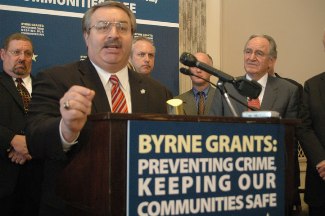
As part of the $825 billion economic stimulus bill passed by the House last week, the Democratic Party leadership and the Obama administration included $3 billion for the controversial Byrne Justice Assistance Grant program, which funds multi-agency drug task forces across the country, and $1 billion for the Community Oriented Policing (COPS) program, which will pay for thousands of additional police officers to hit the streets. Drug enforcement lobby groups are pleased, particularly about the Byrne funding, but others predict that any "stimulus" more Byrne grants might provide will be followed long-term drag on state budgets in ways going beyond the federal dollars.

http://stopthedrugwar.org/files/byrnegrantharkinpressconf04.jpg
Sen. Harkin and Iowa law enforcement officials at 2004 press conference
In one of the few drug policy-related decisions made by the Bush administration that reformers could cheer, the Bush administration tried throughout its second term to reduce or eliminate funding for the Byrne grants. In so doing, it was heeding the concerns of conservative and taxpayer groups, who called the program "an ineffective and inefficient use of resources." But while the Bush administration tried to gut the program, Congress, still tied to the "tough on drugs" mentality, kept trying to restore funding, albeit at reduced levels.

The Byrne grant program, and especially its funding of the scandal-ridden multi-jurisdictional anti-drug task forces, also came in for harsh criticism from drug reform, civil rights and criminal justice groups. For these critics, the program was in dire need of reform because of incidents like the Tulia, Texas, scandal, where a Byrne-funded task force police officer managed to get 10% of the black population of the town locked up on bogus cocaine distribution charges. Scandals like Tulia showed the Byrne grant program "did more harm than good," the critics wrote in a 2006 letter demanding reform.

Of course, Tulia wasn't the only Byrne-related scandal. A 2002 report from the ACLU of Texas found 16 more scandals involving Byrne grant-funded task forces in Texas, including cases of witness tampering, falsifying of government records, fabricating evidence, false imprisonment, racial profiling, and sexual harassment. Byrne-related scandals have also occurred in other states, including the misuse of millions of dollars of grant money in Kentucky and Massachusetts, false convictions because of police perjury in Missouri, and making deals with drug offenders to drop or lower charges in exchange for cash or vehicles in Alabama, Arkansas, Georgia, Massachusetts, New York, Ohio, and Wisconsin.

In accord with its own budget-cutting imperatives, and in response to critics on the right and left, the Bush administration again tried to zero out the Byrne grant program in FY 2008. While the program was indeed cut from $520 million in 2007, Congress still funded it at $170 million for 2008. Now, it has folded the Byrne program and the Clinton-era COPS program into the emergency economic stimulus bill, leading to loud cheers from the law enforcement community.

"Safe communities are the foundation of a growing economy, and increased Byrne JAG funding will help state and local governments hire officers, add prosecutors and fund critical treatment and crime prevention programs," said National Criminal Justice Association President David Steingraber, executive director of the Wisconsin Office of Justice Assistance. "I applaud the stimulus bill proposed by the House Democrats and press Congress for its quick approval."

"This is very encouraging," said Bob Bushman, vice-president of the National Narcotics Officers Associations Coalition and a 35-year veteran of drug law enforcement in Minnesota. "We think it's a very good sign that this was included in the House bill. The House side was where we struggled in past years. Maybe now the House has listened to us and is taking our concerns more seriously," he said. "We built a broad coalition of law enforcement and drug treatment and prevention people."

Byrne money doesn't just fund the task forces, Bushman pointed out, although he conceded that's where much of the money has gone. "Byrne money goes to all 50 states, and most of them used it for the multi-jurisdictional task forces. Here in Minnesota, we split it between task forces and offender reentry programs and drug courts."

While a answer to just how much Byrne money has gone to the task forces remains buried deep in the bowels of the Justice Department -- part of the problem is that the 50 states are awarded block grants and then decide at the state level how to allocate the funds, and some states are better than others at reporting back to Justice -- observers put a low-ball figure of at least 25% going to fund them, and possibly much higher.

The task forces are needed, said Bowman. "While we are never going to arrest our way out of this, I've seen too much of the damage done by drug abuse, and we need all the help we can get," he said. "Not just for policing, but also for treatment and prevention and drug courts. We need all three pillars, and the Byrne program helps with all three."

If law enforcement was pleased, that wasn't the case with civil rights, taxpayer, and drug reform groups. They said they were disappointed in the restoration of funding under the auspices of the economic stimulus bill, and vowed to continue to try to either cut or reform the program.

"We're working on a letter to Congress about the Byrne grants right now," said Lawanda Johnson, communications director for the Justice Policy Institute, one of the organizations that had signed on to the 2006 DPA letter. "The Byrne grant program is not an effective use of funds for preserving public safety or stimulating the economy. The only way you will get an economic boost from this is if you own stock in Corrections Corporation of America," she laughed, grimly.

"With so many smart people working on the budget and the stimulus package, you would think they would understand that the states are looking to reduce their prison populations and change those policies that have jailed so many people," said Johnson. "To then turn around and have the federal government invest $4 billion in more police and more grants seems paradoxical. It's just going to jack up the spending for states and localities, and they are already struggling."

"We oppose the wasteful economic stimulus bill and we oppose the inclusion of the Byrne grants in it," said Leslie Paige, spokesperson for Citizens Against Government Waste, one of the conservative taxpayer groups that has opposed the grants for the past several years. "If there is going to be government spending, the least you can do is make sure the money is going to have a long term positive impact on the economy."

"This is disappointing, but not surprising," said Bill Piper, national affairs director for the Drug Policy Alliance. "This reverses Bush's cuts in the program and restores funding at even higher levels. At the same time Congress and the Obama administration are expressing great concern about racial disparities and over-incarceration, they keep trying to fund this program, which will only stimulate more arrests of more nonviolent drug offenders," Piper noted.

"The Democrats are framing this as helping in these tough economic times, but the people who will be arrested will end up in state prison, and the states will have to pay for that," Piper pointed out. "The states may well end up paying more in the long run. It's far from clear that this will stimulate the economy, but what is clear is that it will stimulate the breaking up of families and decreasing productivity and tax revenues, especially in communities already devastated by the impact of over-incarceration."

Killing funding outright is unlikely, said Piper. "I don't think there's any way we can stop this from being included because the support for it is strong and bipartisan," he said. "No one wants to go up against the police. Our real hope is that later in the year we can put some restrictions on the program, which is what we've been working on. Instead of trying to cut it, we can try to use it to encourage state and local law enforcement to change how they operate. They're so addicted to federal funding that they may do just about anything, such as documenting arrests or having performance measures."

Bushman and the rest of law enforcement aren't resting easy just yet. "The funding has to survive hearings and make it into the final appropriation," he noted. "This is not a done deal yet."

But it looks like Congress is well on the way to funding three more years of Byrne grants at $1 billion a year, the highest level of funding in years. And don't forget the 13,000 new police officers to be funded for the next three years by the COPS program. If Congress and the cops have their way, we can look forward to more drug busts, more prosecutions, more people sentenced to prison, and a greater burden on already deficit-ridden state budgets.

Friday, January 16, 2009

DEA On Marijuana Scheduling

From Stop The Drug War:

http://stopthedrugwar.org/chronicle/567/DEA_rejects_marijuana_rescheduling_petition

Feature: DEA Rejects Yet Another Rescheduling Petition, But the End Game Lies Far Down the Road


The DEA has rejected yet another petition seeking to remove marijuana from Schedule I of the Controlled Substances Act (CSA), this one from Iowa-based marijuana reformer Carl Olsen. It is only the latest petition rejection by the agency in a glacially-paced struggle to reschedule marijuana that has been going on since 1972.

http://stopthedrugwar.org/files/cannabisplants.jpg
marijuana plants
But Olsen and other advocates of the rescheduling tactic say that is to be expected, and the rejection is only the opening phase of this particular battle, not the end of the line. And while Olsen heads to federal court to challenge the DEA ruling, another petition to reschedule marijuana is still in process, as it has been for the past six years.

Richard Nixon was just beginning his second term in office when the National Organization for the Reform of Marijuana Laws (NORML) filed the first rescheduling petition. It took 22 years and numerous court challenges before the DEA finally rejected that petition. In the meantime, the DEA rescheduled marijuana's primary psychoactive ingredient, THC, as a Schedule II drug in 1985 and loosened controls over THC even further by rescheduling it to Schedule III in 1999. That allows doctors to prescribe Marinol, but not marijuana.

Another rescheduling petition, filed by Olsen in 1992, was rejected years later, as was a 1995 petition submitted by former NORML head, researcher, and professor of public policy Jon Gettman. In 2002, Gettman, in association with a long list of supporters, submitted yet another Cannabis Rescheduling Petition, which remains pending.

Under the CSA, he argues, substances must meet several criteria to be placed in Schedule I, the most restrictive schedule. The substance must have a high potential for abuse, it must have "no currently accepted medical use" in the US, and there must be a lack of accepted safety for use of the substance. Both the Olsen petition that was rejected last month (although the decision was not published until this week) and the pending Gettman petition argue that marijuana no longer qualifies to be placed in Schedule I because it does have "currently accepted medical use" in the US, citing in particular the ever-growing number of states that have legalized its medicinal use.

But the two petitions differ in the way they seek to remedy the situation, and it is this difference that accounts for the vastly different pace at which they have been handled by the DEA. While the Gettman petition is still awaiting a ruling six years after it was filed, Olsen's petition was only filed this year. The Gettman petition seeks to reschedule marijuana through the administrative process, the Olsen petition argues that the issue is a matter of statutory law. Under the CSA, if marijuana is found to have "currently accepted medical use," it cannot be Schedule I.

"I filed in May, filed a federal lawsuit in September, and got a ruling December," said Olsen. "The DEA has never moved that fast on a petition in its history, and by denying the petition, it is avoiding the possibility of having to deal with it again because now it will instead go back to the court of appeals."

Olsen's petition was not a request, but a demand that DEA recognize the reality that marijuana cannot be a Schedule I drug, he said. "I didn't ask for anything; I demanded that they comply with the law. It's not a Schedule I drug, and they are breaking the law by keeping it there," he said. "The statute says it can't be a Schedule I drug if it has accepted medical use, and 13 states say it has accepted medical use. Doesn't that mean anything?"

Not according to the DEA it doesn't. "Your petition and notice rest on your contention that federal drug law gives states the authority to determine, for purposes of the CSA, whether a drug has a 'currently accepted medical use in treatment in the United States,' and that marijuana has such a currently accepted medical use because 12 states have passed laws relating to the use of marijuana for medical purposes," wrote DEA Deputy Administrator Michele Leonhart in denying the petition.

Leonhart cited the Raich medical marijuana case in arguing that marijuana has no "accepted medical use" because the federal government doesn't recognize it, and even quoted from the decision: "The Supremacy Clause unambiguously provides that if there is any conflict between federal and state law, federal law shall prevail," and "Congress expressly found that [marijuana] has no acceptable medical uses."

Leonhart also quickly disposed of additional arguments presented by Olsen, summarizing her position by finding that "the existence of state legislation is not relevant to a scheduling determination." Thus, "there is no statutory basis for DEA to grant your petition to initiate proceedings to reschedule marijuana. Nor is there any basis to initiate any action based on your August 5th notice. The Petitioner's request is denied."

Now, it will be up to the federal courts to decide who is right. "The court has to rule on my complaint to enjoin the DEA from enforcing Schedule I," said Olsen. "If they rule in my favor, the DEA cannot claim it is a Schedule I drug; it will have to remove it from Schedule I."

In either case, the losing side will appeal. Look for a resolution of the Olsen case some time in the not-so-near future.

That's just how Olsen planned it, said Gettman. "I wasn't surprised at the DEA decision, and I don't think Carl was either," he said. "The whole point of his petition was to get this into federal court, and to do that, he had to be rejected administratively. This is really the beginning of Carl's legal challenge rather than the end."

Gettman credited Olsen with breaking new ground with the petition and even for inspiring Gettman himself to get involved with rescheduling. "Carl's arguments greatly clarify and build on state-level recognition of medical use, and set the stage for greater attention to this matter," he said. "And I have to say that Carl's activity and pioneering efforts are one of the things that inspired me to file the 1995 petition in the first place."

Meanwhile, Gettman's petition is still pending, although it has already moved through several stages of a lengthy bureaucratic process involving the DEA, the Department of Health and Human Services and the Food & Drug Administration (FDA). "The last time we got a status report from FDA, they were nearing the end of their review," Gettman reported.

He is no hurry right now, he said. "We have deliberately decided not to pressure the government to complete the review. We would prefer to deal with the next administration instead of the current one," he explained. "Regardless of how the election turned out, we would have new personnel overseeing the process, and we think a fresh perspective would be beneficial."

Even if the FDA were to come down with a favorable review, there are many steps between that and actually rescheduling marijuana, and even then, the fight over marijuana will still be underway, said Gettman. "Rescheduling will not make medical marijuana available right away and it is not the end of deciding marijuana's regulatory status, it's the beginning," he said. "But it would change the regulatory environment and make it easier for states to accelerate the pace of reform, as well as make it easier for human studies to get under way and for companies to develop marijuana as a medical substance. Schedule I status discourages companies from doing that."

NORML founder Keith Stroup, who was in on the original 1972 rescheduling effort applauds Gettman's and Olsen's efforts, but said he has lost faith in ever gaining redress through that process. "I just don't believe anymore that the rulemaking process is ever going to work in our favor," he said. "We've been trying since 1973, and I think we're going to have to win this the old-fashioned way, through the legislative process or voter initiatives. I just don't think the people in those agencies have the principled courage to do the right thing," Stroup added.

"Still, I'm pleased that Carl and Jon continue to pursue these avenues," he said. "It's to our advantage to put pressure on the system wherever we can."

Whether it's a long-shot or not, the effort to change the marijuana laws through seeking rescheduling is not going away. And who knows? It might actually pay off big one of these years.

Politics & Advocacy Federal Courts - DEA - Congress

Tuesday, November 11, 2008

Coca, Bolivia, and 'Law' 1008


Coca, Bolivia, and Law 1008
Drug War Rant Friday, March 7, 2008
http://rcs.salon.com/rcsComments/comments?u=2762&p=3114&link=http%3A%2F%2Fblogs.salon.com%2F0002762%2F2008%2F11%2F10.html%23a3114

There's a fascinating 5-part series of videos on Bolivia and coca at vbs.tv. Definitely worth watching -- I learned quite a bit about the coca leaf. I was particularly interested in Law 1008 -- a law written by an American in English controlling what Bolivians could do with their coca leaves. A law, like every drug prohibition law, that had roots in racism and lies. And a law, like every other drug prohibition law, that actually caused the conditions for developing a massive international black market.

The first three parts of the video are the most interesting, and you do have to get past the smarmy fashion disaster correspondent, but it's worth it.
Thanks to Drug War Flipside


Coca Cookies and Constitutional Dreams By Jean Friedsky
Special to The Narco News Bulletin December 2, 2005

Decriminalization and How It Could Change Life for Bolivia’s Cocaleros


Coca leaves at market.
Photo: D.R. 2004 Jeremy Bigwood

The Contradictions of Coca Eradication in Bolivia By Reed Lindsay
Narco News Authentic Journalism Scholar
February 15, 2003

The drug war in Bolivia has hit a brick wall. While the Bolivian government wiped out more than 70 percent of the nation’s coca production in the late 1990s, the U.S.-backed eradication program has ignited a firestorm of opposition from coca growers, called cocaleros, in the Chapare region of central Bolivia. A growing movement of coca growers has not only stopped the eradication program in its tracks, it has gained widespread popular support that nearly swept cocalero leader, Evo Morales, into the presidency.

Behind the failure of the U.S.-promoted eradication policy in the Chapare region is a gross misunderstanding of the use of coca leaves in Bolivia and elsewhere, say activists and experts attending the Out of the Shadows drug legalization conference in Merida, Mexico.

Coca leaves have been consumed and used for thousands of years in Bolivia for medicinal and religious purposes. Today, coca is primarily “consumed orally,” in a manner similar to chewing tobacco, but it is also used to make tea and in indigenous ceremonies.


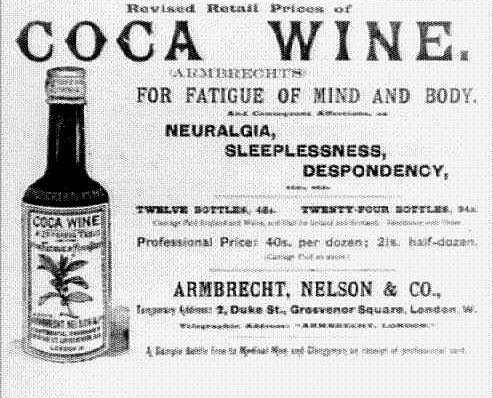
Peruvian Vintage Wine of Coca...
According to the Sears, Roebuck and Co. Consumers' Guide (1900)

A POLITICAL DRUG WAR IN BOLIVIA By Jens Gluesing
Is Coca the New Hemp? March 28, 2006

Bolivian President Evo Morales has put a stop to the eradication of coca plantations, triggering fears in Washington of a new wave in the illegal drug trade.


Bolivian President Evo Morales wants to make coca leaves the new hemp, but critics believe his promotion of the plant used to create cocaine will just boost the illegal drug trade.

The wine, a bit on the sweet side, is supposedly a remedy against Parkinson's disease and impotence and, according to the label, it is especially suitable for "athletes and singers." In small doses, that is, because the wine is pressed from coca leaves, enhancing the effect of the alcohol. If you get drunk, you don't have to worry about how you're going to feel the next day because "coca wine doesn't cause a hangover," says Melby Paz.


A Word From Our Sponsor...
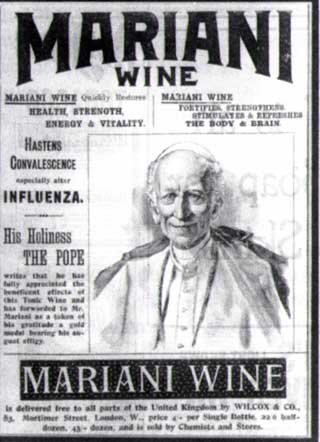
His Holiness The Pope enjoyed the invigorating properties of coca wine. Leo XIII carried a personal hipflask to fortify himself in time of need. A grateful Pope awarded a Vatican gold medal to its distinguised orginator, the Corsican-born pharmacist and businessman Angelo Mariani. Mariani had a keen eye for the benefits of celebrity-endorsement.

ANDEAN DRUG WAR UPDATE By Bill Weinberg

Dissent Against Washington's Drug War Emerges as Chaos Spreads


Bolivia and Peru defend coca use


The UN lists coca as a controlled substance like cocaine or opium
Tonnes of coca leaves grown illegally in the village of Huaculi, central Bolivia, are burnt (Dec 2007)

The UN lists coca as a controlled substance like cocaine or opium
Bolivia and Peru have defended the continued, traditional use of coca leaves after they were criticised by a UN drugs agency report.


cocaine toothache drops (1885)

Sunday, August 17, 2008

1913- "Poisons And Habit Forming Drugs"

As Defined by the U.S. Government

I suggest Salvia Divinorum is being placed on Schedule I precisely because of the great potential for medical uses it presents.

"Schedule 1" scheme to lock up research

From http://stopthedrugwar.org/chronicle/547/kenneth_rau_salvia_five_years

(excerpt)

The founders of the United States of America set up a Constitution under which to deny a personal of fundamental rights of speech religion and freedom from imprisonment required, the government to have a very strong or compelling reason.

The question the legislature should address is whether there is a good reason to prohibit Salvia Divinorum and more significantly to imprison people for years. The legislation proposed putting Salvia on Schedule I which prohibits any medical research. Why did not one question arise in either the North Dakota House or Senate committees or on the House or Senate floor as to why Salvia had to have the highest scheduling and as a felony? Why not an infraction or a misdemeanor? I suggest Salvia Divinorum is being placed on Schedule I precisely because of the great potential for medical uses it presents. There are numerous independent and university researchers investigating Salvia right now. When it goes on Schedule I their research will stop forever. Only the largest members of the Pharmaceutical Cartel will be able to develop Salvia's medical potential when it suits them.

My name is kenneth Rau and i can be contacted at defendantkennethrau@yahoo.com


Kenneth Rau

http://bismarcktribune.com/articles/2008/08/03/news/topnews/161483.txt

Kenneth Rau- Legal Status of Salvia Divinorum

In April 2008 the case of Bismarck resident Kenneth Rau, a 46 year old bottling plant worker, was reported as likely being the first person charged for Salvia divinorum possession in the United States. He was arrested on April 9, 2008 when police searched his home looking for his adult son, who was on probation for drug charges.

Burleigh County States Attorney Cynthia Feland confirmed, "He is being charged with possession of salvia with intent to deliver". Rau suggests that this is a long used drug prosecutors ploy "to make dealers out of everyone," saying of his untreated leaf, "Nobody wants leaves. Everyone is buying those 10X and 20X and 30X extracts." [...] "I bought eight ounces of leaf on eBay by bidding $32 for it. Now they're charging me with possession with intent." [...] "This is ridiculous since an ounce is clearly the standard saleable unit for [untreated] leaf."

Rau's interest in salvia was reported as deriving from a broader interest in herbalism, religion and spirituality. - "I read that salvia facilitates lucid dreaming, so I tried chewing some leaves before bed time, and it was interesting because I would see faces and remember names I had long forgotten." He also tried salvia as a cure for depression. "I have some childhood issues to deal with. They had me on Paxil," he said. "They want you to take their pharmaceuticals, but if you want to take an herbal remedy, they want to throw you in prison. Are they going to save me from myself by throwing me in prison for years?"

Rau said his arrest has motivated him. "Maybe this is an opportunity for me to join the fight. I've never been a drug user, never been arrested. I started experimenting with this stuff because I thought it was legal. I didn't want to get into trouble, but now they're treating me just like some meth dealer." [...] "I've emailed the ACLU Drug Law Reform Project, but I haven't heard back from them yet."

The Drug Reform Coordination Network (DRCNet) reported that it had contacted Republican lawmakers, state Sens. Dave Oelke and Randel Christmann and state Rep. Brenda Heller, but none of the three legislators responded to requests for comment.[79]


US Establishing Religion Upon Presumption of Compelling State Interest

Arizona Court Subverts 1st/9th Amendment of Freedom of Medicine and Diet via establishing religion of pharmcratic inquisition

Arizona Court of Appeals Rejects Religious Defense

from Drug War Chronicle, Issue #546, 8/8/08

In a July 31 decision, the Arizona Court of Appeals has held that there is no religious right to possess marijuana. In so doing, the court rejected the appellant's argument that his right to possess marijuana for religious reasons was protected by both the Arizona and the US Constitution.

The ruling came in Arizona v. Hardesty, a case that began when Daniel Hardesty was pulled over by a police officer in 2005 and subsequently charged with possession of marijuana and drug paraphernalia after the officer first smelled smoked marijuana in the vehicle, then found a joint Hardesty admitted tossing from his window. Hardesty, a member of the Church of Cognizance, argued at trial that he used marijuana for religious purposes and should be exempt from prosecution under both Arizona and federal law. The trial court disagreed.

Now, so has the appeals court. While the court accepted that Hardesty's religious beliefs were sincere, it rejected his arguments that under the free exercise of religion, he had the right to use marijuana as a sacrament. Hardesty had conceded that marijuana is a drug that could have harmful effects and that the state had a "compelling interest" in regulating it, but argued that it had not been regulated it in a manner that was "least restrictive" when applied to religion.

In his opinion, Appellate Judge Sheldon Weisberg wrote that while the First Amendment guarantees an absolute right to hold a religious belief, it does not guarantee the same absolute right to put that belief into practice. Similarly, Weisberg held that provisions of Arizona law designed to protect religious freedom did not encompass the religious use of marijuana, citing the state legislature's outright ban on the use and possession of marijuana.

"This statute does not provide any religious exemptions nor does it contemplate an exemption for the use of marijuana that would be consistent with public health and safety," the judge wrote for the unanimous court. "By imposing a total ban, the legislature has deemed that the use and possession of marijuana always pose a risk to public health and welfare."

But the appeals court did leave open the possibility that it could decide differently if someone came before it persuasively arguing that marijuana is not as dangerous as the government suggests. In that case, the "compelling interest" of the state in maintaining a complete prohibition on marijuana would presumably be weakened.

It's a religion of prescribed medicine and diet, particularly with its disregard for science and hence its subversion of public health.

And while were at it, the pharmacratic inquisition is a criminal racket insofar as its longstanding double standard with such things as cigarettes of Tobacco- furthermore a reason for jailing judges that perpetuate this travesty of criminal mercantilism.